Hobsonville Point Secondary School is a new Modern Learning Environment School that opened in 2014.
We are situated within the new development of Hobsonville Point (on the former Air Force base). We are a state funded, co-educational secondary school. Whilst we will eventually operate as a full Year 9-13 high school, we are currently only offering a “foundation programme” to Year 9 and 10s, with Years 11, 12 and 12 programmes being added over the next three years. We are a decile 10 funded school with all students being taught within the English Medium.
The history of the school/institution and its staffing
The senior leadership team were appointed at the end of 2012, giving us a full year to engage in research and planning. Hobsonville Point Secondary School opened it doors to students in 2014. We are a MLE (modern learning environment) which means we are a large open plan school, typified by open flexible learning spaces, break out rooms and specialised learning spaces. The furniture is varied, including high bar leaners, mid-level desks, tables, low tables and bean bags. The space and fittings designed to move from caves, campfires to watering holes. We are also a PPP school which simply means that we have another company managing our property (from property maintenance to cleaning) - which means we can focus purely on teaching and learning.Over the first three years (and first two years of operation) we have established the following curriculum design.
Vision
The vision for our school is to create a stimulating, inclusive learning environment which empowers learners to contribute confidently and responsibly in our changing world.Principles
The foundations of our curriculum decision-making are to:- Innovate through personalising learning
- Engage through powerful partnerships
- Inspire through deep challenge and inquiry to develop empowered learners
The curriculum and student week is made up of three key components - learning hubs, specialised learning and project learning.
Learning Hubs
Learning Hubs will:
- be small groups where caring relationships are fostered
- provide learners with one key person who will connect with family and ensure learners are engaged in a relevant and challenging programme
- explore learner interests in order to pursue passions, which can be linked back to learning
- track progress and provide structures so learners, with their coaches and families, can maintain a learning portfolio
- build on learners' capacities to be Inquirers and Self Directed Learners
Specialised Learning Modules:
- will enable all students to gain coverage of curriculum areas and fluencies
- will include a range of teaching & learning modes: co-constructed, seminar, workshop, flipped, online etc.
- will encourage critical and creative thinking
- will be framed by inquiry and involve independent learning activities
Project Learning
Students will be engaged in at least one project at any time. This allows student choice through personal interest and develops lifelong skills of collaboration and complex problem-solving.
Big Projects are:
- larger scale, links with internal or external expertise/mentors, business partnerships, community links, encourage social responsibility & citizenship
- apply learning across curriculum areas with focus e.g. Wetlands
- exposure to wide range of learning experiences, scope for student participation across range of roles
Timetable Structure
The image below shows the new timetable structure as of Term 3 2015. It is interesting to note that this is the fourth timetable structure we have had in less than two years. This has come about through our semesterly review of the timetable - we began by having three module types (big learning module, small learning module and special interest). All modules were term long in the first year. Big learning modules ran for a full day with three learning areas integrated, led by three curriculum specialists. This module design was removed after feedback from staff and students suggested that it was difficult to give all three learning areas equal attention, therefore it was decided to replace this with a third small learning module. Other changes that have taken place in 2015 is the shift from term long to semester long small modules (to enable deeper learning over time) and a shift from single year level group modules in semester one, to a full composite programme being implemented for the foundation programme in semester two. Modules are now carefully differentiated to address a wider range of curriculum levels.
Monday | Tuesday | Wednesday | Thursday | Friday | |
8.30 – 8.45 | Staff kitchen table | Community staff kitchen table | Big Projects staff kitchen table | Modules staff Kitchen table | Staff professional learning (8.30 - 9.30) |
8.40 - 8.50 | Student Check-in | Student Check-in | Student Check-in | Student Check-in | |
8.50 – 9.00 | Learning hub | Learning hub | Learning hub | Learning hub | |
9.00 – 10.30 Block 1 | Extended Hub | SLM 3 | Big Projects | SPIN 1 | Extended Hub (9.30 - 11.00 |
10.30 – 10.50 | Interval | Interval | Interval | Interval | Interval (11.00 - 11.20) |
10.50 – 11.50 Block 2 | SLM 1 | My Time | Big Projects (10.50 - 12.20) | My Time | SLM 2 (11.20 - 12.20) |
11.50 – 1.20 Block 3 | SLM 2 | SLM 1 | MyTime (12.20-1.20) | SPIN 2 | SLM 3 (12.20 - 1.20) |
1.20 – 2.00 | Lunch | Lunch | Lunch | Lunch | Lunch |
2.00 – 3.30 Block 4 | SLM 2 | SLM 1 | Extended Hub | SPIN 3 | SLM 3 |
Table 2: Timetable as of Term 2 2015
At present the timetable structure consists of:
Small Learning Module (SLM) is a three 90 minutes block per week module that is made up of two learning areas and two teachers working together to lead an integrated module.
Special Interest (SPIN) is a single 90 minute block per week module that has a singular curriculum focus and is led by one teacher.
All modules are designed to relate a term long concepts (see below). Students select modules with support of their Learning Coaches to ensure curriculum coverage is achieved.
Foundation Years Big Concepts (termly) | |||
Identity | Space & place | Citizenship | Systems |
Culture & diversity | Relationships | Innovation | Transformation |
Table 3: HPSS Foundation Programme Concepts
Learning Hubs take place every day, with three 90 minute blocks to allow times for one-on-ones, e-portfolio development and 'learning to learn' type sessions to take place. These have been designed around the three areas of: My Learning, My Being and My Community.
The Big Project takes places every Wednesday.
Professional Learning takes priority every Friday morning (with activities being offered to students who need to arrive early).
MyTime is a flexible period that is used to provide curriculum specific support as needed and time for student led and staff supported interest groups and self-directed time (under the watchful eye of MyTime facilitators).
Staffing
As part of the policy supporting new (and smaller) secondary schools to offer a full range of subjects, we are overstaffed for the first three years. In 2014 we were entitled 19.88 full time teaching staff (for approx 140 students) and 26.18 full time teaching staff (for approx 245 students).
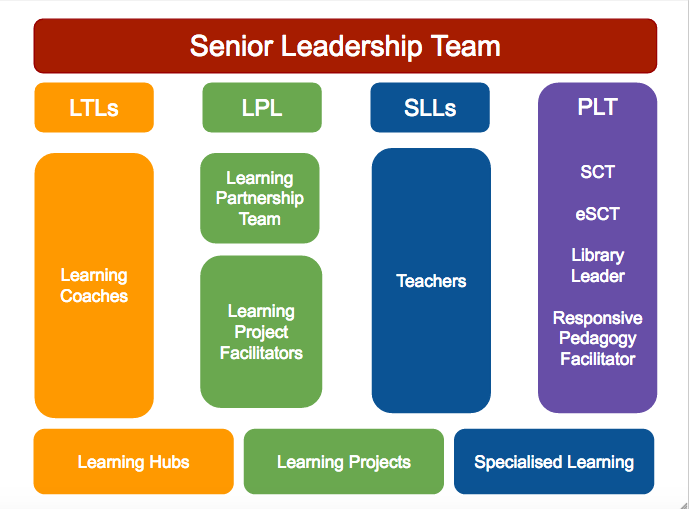
Rather than following traditional secondary school staff structures that are based around learning areas, we instead created a structure that reflected our specific curriculum structure. Throughout the first two years we have had four key teams: specialised learning leaders (who oversee learning module and wider learning design), learning team leaders (who oversee learning coaches and the learning hub curriculum), learning partnership leaders (overseeing project learning) and the professional learning team (overseeing our professional learning programme). All of these teams are overseen by the senior leadership team made up of Maurie Abraham (Principal), and Lea Vellenoweth, Di Cavallo and myself (Deputy Principals).