We talk all about more on Education.....

Showing posts with label relevance. Show all posts
, , ,

5 Ways to Create Relevant Cultures of Learning

Education can seem like a balancing act between what we as adults feel is essential and what interests our learners.  The struggle is real as the former is sometimes emphasized as a result of a school or district’s focus.  Make no mistake about it – capturing the attention of students has become harder and harder because of the access that many of them have to knowledge, games, and each other through technology.  As difficult as it might be, schools must rise to the occasion. To authentically engage kids today, a central purpose has to be instilled through a combination of a relevant context and application. Without it, learning many concepts as well as the bigger picture doesn’t make sense to students.  The benefits speak for themselves, which compels all of us to ensure that this becomes a mainstay in pedagogy as well as learning environments. 

Success lies in a shared ownership approach to design relevant cultures of learning.  It is important to note that this task does not just fall squarely on the shoulders of teachers. However, their role in the process is critical. Below are three questions that kids should be able to answer if learning is relevant:
  • What they learned
  • Why they learned it
  • How they will use what they learned outside of school

Image credit: Erik Francis

To dig a little deeper Robin Roberson discusses two fundamental ways to provide relevance to students aligned to research. These include utility value and relatedness. 
Utility value answers the question “Yeah, but what am I gonna use this for?” Utility value is purely academic and emphasizes the importance that content has for the students’ future goals — both short-term and long-term goals (Ormrod, 2006). 
Relatedness, on the other hand, answers the question “What’s this have to do with me?” Relatedness is an inherent need students have to feel close to the significant people in their lives, including teachers (Ryan & Deci, 2000). Relatedness is seen by many as having nonacademic and academic sides. The nonacademic side of relatedness emphasizes the relationship the instructor has with students. Integral to this side of relatedness is the understanding that students need to feel close to their teachers and are more likely to listen to, learn from, and perhaps identify with the ones they like (Ryan & Deci, 2000).
What happens in the classroom through the relationship-building expertise of teachers needs to be supported and enhanced across the entire school or district.  Herein lies the vital role leaders play in designing relevant cultures of learning.  A systemwide focus on meaning and purpose across all grade levels and content areas goes a long way to supporting a consistent interest in learning.  There is no right way to accomplish this as you will see from the examples below.  

Theme-Based Schools

Schools that have embraced this ideal have a central purpose that is embedded across grade levels and throughout the entire curriculum.  The theme serves as a conduit to connect various content areas and concepts to impart a greater sense of relevance whether it be in the classroom, hallways, or cafeteria.  Recently I observed a great example of this during a coaching visit with Kay’s Creek Elementary School in Farmington, UT.  Their theme focused on global goals for sustainable development.  As you will see below, not only were the goals clearly visible, but each wing of the building highlighted the main components of the environment. Video displays and interactive activities were also found in each of the main entrances to further engage learners in the theme.


Academies

Academy programs represent a bold new direction for education, one that considers student interests, national need, and global demand for highly qualified graduates capable of competing at the most challenging levels. They provide a defined framework for studies in well-defined, career-focused areas directly connected to university majors and workforce need. These programs cultivate emerging professionals who exhibit the knowledge, skill, character, and work ethic necessary for success in the global marketplace. To provide more learning opportunities for our students, the Academies @ New Milford High School were launched during my tenure as principal. Think of it as a school within a school. 

The entire program was designed using existing high school courses as well as adding new ones to complement the three Academies—STEM (Science, Technology, Engineering, and Math), Arts & Letters, and Global Leadership—without costing the district precious financial resources. Any learner, regardless of GPA or learning disability, could be a part of these. Students graduated with a mini-major specific to their interests.  To help build the program, junior academies were created at the middle school to spark interest and function as a feeder pipeline. To learn more about our specific academies click HERE. 

A Unifying Focus 

I was torn as to whether or not I should include this in the theme-based or a standalone category. Obviously, I chose the latter.  A unifying focus bridges curriculum, instruction, and assessment to a school’s vision and mission. While every school has a mascot and logo, it is rare to see how these are connected to the elements outlined in the previous sentence.  Wells Elementary School in Texas is a great example of how a unifying focus becomes a reality.  When the school opened the kids and staff selected the “Explorers” as their mascot and from there on out the goal has been to create an innovative culture where kids actively explore learning through blended pedagogical pathways, outdoors, and in flexible spaces.  The focus is strengthened by the school’s commitment to social media to consistently share and reinforce how everything they are doing centers on the whole child and high levels of student agency. To see what I am talking about check out #ExploreWells.

Specialized Programs

Many districts and schools are providing supplements or enhancements to the curriculum to impart more relevance amongst learners.  These can range from traditional electives or more innovative options that align to student interests and current trends in the workforce. Some schools are taking it a step further to upgrade to learning environments while providing even more opportunities to engage students authentically. Be sure to check out what Mt. OIive High School in New Jersey has done in this area. 

Makerspaces

There isn’t much I have to say here as I have written on the topic extensively over the years. Makerspaces function as an oasis for learners who will never do well on a standardized test or succeed in a traditional classroom environment as that is not how they learn.  These spaces foster open-ended exploration, tinkering, making, and creating to learn. Many at-risk kids thrive here as they can learn with their hands while coming up with innovative solutions to problems that align with the real world.  Below are some pictures of makerspaces at New Milford High School and Mt. Olive Middle School in New Jersey.


I am sure there are many other great ideas out there that have positively impacted kids across the world. Creating relevant cultures of learning is the responsibility of all who serve kids, not just teachers in the classroom. This includes administrators, boards of education, parents, legislators, and other pertinent stakeholders. If the goal is to improve an array of outcomes and genuinely prepare kids for the workforce now and in the future, a relevant culture is a necessity. 

Ormrod, J.E. (2006). Educational psychology: Developing learners (5th ed.). Upper Saddle River, N.J.: Pearson Education, Inc.


Ryan, R.M., & Deci, E.L. (2000). Self-determination theory and the facilitation of intrinsic motivation, social development, and well-being. American Psychologist, 55, 68-78.

Share:
Read More
, ,

The Two Most Important Questions to Ask to Determine if Learning is Taking Place

There are so many thoughts and ideas as to what learning really looks and feels like. From these conversations, educators form their own perspectives and opinions that best align with the vision, mission, and goals of their classroom, school or district.  However, a consensus is critical if the goal is scalable change that results in improved learning outcomes. As I have written extensively in the past, research and evidence should play a significant role in what learning can and should be as well as whether or not it is actually taking place.  Common vision, language, expectations, and look-fors go a long way to creating a vibrant learning culture.

Recently I posted the following tweet. 


It seemed to resonate with many educators.  I decided to post this update when I saw my friend Greg Bagby share an image of the Rigor Relevance Framework where technology is considered. Thus, my tweet referenced a digital angle.  In hindsight though, I should have written the tweet to align with what I genuinely believe in.  Some of the commentary I received reinforced what I always speak and write about as well as coach on; that the two questions I posed are important both with and without technology.  So, when it comes to learning, the two most important questions are:

  1. Are kids thinking at increasing levels of knowledge taxonomy?
  2. How are kids applying their thinking in relevant ways?

The Rigor Relevance Framework provides a practical way to determine the answers to both of these questions by looking at the level of questioning and the tasks that kids are engaged in.  


Consider it a litmus test of sorts. Where do the instruction (what the teacher does) and the learning (what the kid does) fall in terms of the four quads?  Good instruction can, and should, lead to empowered learning, with movement along both the thinking and application continuums. The point here is to not reside in Quad D as that is a place you visit once and a while, but it should be an area that learners are moved to at some point during a unit of study. When technology is added to the mix, it should be utilized purposefully by the learner in ways that address the two questions posed above.


The image above conveys a critical point.  We should never look at technology as a distinct element separate from curriculum, instruction, and assessment.  Each of these in their own right intersects in ways to support and enhance learning. It is essential to understand that the role of any digital tool or experience is to empower learners to think in ways that represent a fundamental improvement over traditional practice. The use of technology leads to yet another critical question – How are kids using technology to learn in ways that they couldn’t without it? 

All in all, learning has to be the focus. It’s up to you to determine if it is, in fact, taking place and if not what can be done to ensure that it is. 
Share:
Read More
, , , ,

3 Shifts to Make Learning Personal

In education, a lesson makes or breaks a learner’s experience in a classroom.  Planning takes time. I remember many nights and weekends that I spent countless hours developing a variety of activities that would keep my students engaged while also following the scope and sequence of the curriculum based on the standards that needed to be addressed.  When it is all said and done, it is more about the experience than the lesson, but the latter is necessary to create the former.  The key to strengthening learning and instruction consists of the right balance of two main components:

  1. Instruction (what the teacher does)
  2. Learning (what the student does)

Balance surely is important. There is a time for direct instruction, but many learners would tell you outright that this component of a lesson is not what they really crave or find meaningful. In Learning Transformed Tom Murray and I examined research and evidence to conclude that kids want a learning experience that is personal while educators want alignment with the real expectations placed on schools across the world.  Finding common ground in this area at times poses quite the challenge.  Any personalization necessitates a move from “what” to the “who” to emphasize ownership of learning.  Sounds simple enough right?  Getting everyone on board becomes the challenge.

Make the shift to personal learning goes right back to finding the right balance between instruction and learning.  Success in this area requires a shared vision, language, and expectations that not only make sense, but also jive with curriculum, standards, and assessment.  Enter the Rigor Relevance Framework.  Now I am not going to rehash the details of this tool as I have been writing about it for years, but I will provide an image of it below. The essence of the framework is quite simple as it allows for a lens for teachers and administrators to determine the level of thinking and relevant application that kids demonstrate while engaged in the process of learning. Instilling a purpose of learning while challenging all kids in the learning process is at the heart of a more personal approach.


Solid instruction should lead to great learning where kids are in the proverbial driver’s seat.  The Rigor Relevance Framework unearths three critical shifts in practice that can lead to personal learning experiences for kids.  As I love using images to articulate ideas and concepts, I will frame each shift with a question that will then be described in more detail using an associated image.

Shift 1: Are learners telling us what they know or showing that they actually understand?


Shift 2: Who is doing the work and thinking?


Shift 3: Who is asking the questions?


There is obviously more to consider when embracing and implementing the shifts listed above.  A personal learning experience doesn’t sacrifice higher-level thinking and application just for the sake of relevance and meaning.  Sound pedagogy lays the foundation with an added emphasis on scaffolding, innovative assessment, and improved feedback.   Student agency and technology both play a huge role throughout by empowering learners through choice, voice, and advocacy.  When these are combined to create effective blended learning activities in flexible spaces, the added elements of path, pace, and place further influence the personalization that will help kids flourish regardless of zip code or label.

However, it is the third shift that tells the tale as to whether a lesson or task supports rigorous and relevant learning to create a more personal experience for kids.  If kids see and understand the purpose while being challenged, then they will be asking the questions.  Better outcomes rely on transforming practice in a way that kids of the present and future can relate.  Making learning personal is a means to this end. 
Share:
Read More
, , , ,

What Are Your Beliefs?

What do you believe in professionally? We all possess a particular set of beliefs that are shaped by our respective value system.  

These impact our work and ultimately determine whether we are successful or not. Mark Lenz provides this great perspective:
Beliefs. We all have them. They came from somewhere. They probably started forming in us as young children and have been strengthened through time. Or maybe they’ve changed over the years. Changing a belief or a belief system is a big deal because our minds are wired to think that our beliefs are the correct ones. It’s been said we are creatures of habit. That’s because we believe the way we do things, the way we think, is right.
I would wager that many of our beliefs in education stem from how we were taught at some point. It is also fair to say that others developed based on how we were led or what others modeled for us.  In either case, once beliefs are in place, people have a hard time changing them when challenged as Lenz alluded to above.  The fact of the matter is what we believe in, can and should evolve. In a world influenced by disruptive change and where information is readily accessible it only makes sense that we are open to adapting what we currently believe in or even developing a whole new set of beliefs.


Having a set of beliefs that align with professional values can be a tremendous asset when it comes to creating a vibrant learning culture primed for success. Mine have certainly changed over the years in large part to first moving from a fixed to growth mindset and my experiences as a teacher and administrator.  They continue to evolve now based on my work in schools, current research, and evidence as to what actually works in what seems like an ocean of never-ending opinions on what educators should be doing.  

Here is what anchors my current belief system.

All kids can learn.

Regardless of zip code or label, every single student who walks into a school is capable of learning. We must be cognizant of the fact that each child is unique and as such he or she learns differently. For this fact alone, we must be open to differentiated and personalized pedagogical strategies. All kids have greatness hidden inside them. It is the job of an educator to help them find and unleash it.

Purpose in learning must be a priority.

School should unleash student passions and creativity, not stifle them. If there are relevance and meaning, kids will be able to tell you why they are learning something, how they will use it outside of school, and what they actually learned. Curriculum and standards are essential, but so are the interests of students as well as the opportunity to authentically apply new knowledge. 

Technology can be a game-changer with a solid pedagogical foundation.

Tools of the digital world provide the means to support and enhance learning like never before.  When adopting a pedagogy first, technology second, and with an appropriate mindset, purposeful use can innovate assessment, increase collaboration, improve feedback, transform time frames (where, when), and empower kids to own their learning like never before. 

Just because it worked in the past doesn’t mean it still does.

The past teaches us not to repeat the same mistakes. The information age has taught us to take a critical lens to practice to improve. We now know that certain homework and grading practices are not effective. If we employ the same type of thinking, then we will get the same old results, or they might be less than what we want. Take the time to reflect on past practice to improve current practice. 

Look through an empathetic lens.

It is impossible to know what is going on in the minds of kids.  Sometimes things can be so bad that they either act out or shut down.  In the words of Jackie Gerstein, “All kids have worth. Some, though, want to prove to us that they have none. Our job as caring educators is to prove them wrong.” When times get tough with kids, try to put yourself in their shoes.

Spaces and environments should be more reflective of the real world.

Ask yourself if you would want to learn in the same spaces and under the same conditions as all of the kids in your school.  If the answer is no, then it is time to embrace a new belief.  Research has shown that classroom design (furniture, layout, temperature, color, acoustics, lighting) impact learning. Elements such as comfort, flexibility, and choice provide the needed elements for blended learning that can meet the needs of more kids.

A push for efficacy benefits all.

I will sound like a broken record here as I have written so much on this topic over the years. Evidence, research, and accountability all matter if we are serious about scaling change. A focus on each of these areas brings more credibility to ideas and strengthens collective calls for innovative change. Efficacy matters plain and simple. 

Chase growth, not perfection.

In education, there is no perfect lesson, teacher, administrator, school, or district.  There is always room for improvement. It took me a while to adopt this belief but has probably impacted me the most as of late.  Striving to be a better iteration of ourselves each day can help us be the best for those we serve.

What do you believe in? Please share in the comments section below. 

Beliefs and values help to not only guide but also influence our work. As everything around us evolves, so should our thinking.  Being open to this shift will go a long way to growing professionally and creating schools that work better for kids. 
Share:
Read More
, ,

The Purpose of Content

When I think back to my days as a learner, the content seemed to be at the forefront of every class.  Whether it was disseminated during a lecture in college, through direct instruction in K-12, or at times consumed from a textbook or encyclopedia, it was everywhere.  The more I think about it; content was predominately the focus in every class. Day in and day out a repetitive cycle ensued in most classes where my classmates and I were given information and then tasked with demonstrating what we learned, or in a few cases, constructing new knowledge.  The bottom line is that I, like many other students at the time, did school and never really questioned the means or process. In the end, it was about passing the test plain and simple. 


Now I am not saying that content is not valuable or not needed as a basis to move from low to high-level learning.  It goes without saying that a certain amount of content is required like learning letters and numbers to be able to move to different levels of knowledge construction in language arts and mathematics respectively.  But let’s face it, as learners progress through the system, content, and knowledge for that matter can be easily accessed using a variety of mobile devices.  This then begs the question – how relevant is content really in a knowledge-based economy that continues to evolve exponentially thanks to advances in technology?

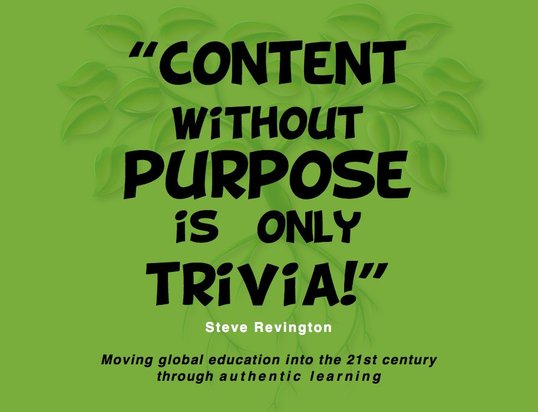
When reflecting on the last question in the paragraph above, I think about the following quote from Steve Revington, “Content without purpose is only trivia.” Learners today are not as compliant or conforming as many of us were back in the day nor should they be.  Whether we are talking about authentic or relevant learning, kids inherently want to know what the higher purpose is and who can blame them.  


When content has a purpose and is applied in relevant ways to construct new knowledge, learners will be able to tell you:
  • What they learned
  • Why the learned it
  • How they will use it both in and out of school
A lesson, project, or activity that is relevant and has purpose allows learners to use both the content and their knowledge to tackle real-world problems that have more than one solution. The shift here is key.  Engagement for learning empowers kids to put knowledge to use, not just acquire it for its own sake.  Many yearn for and deserve to use content and acquired knowledge to solve complex, real-world problems and create projects, designs, and other works for use in real-world situations. The value in content relies on how it is applied to develop thinking in a purposeful way further.  

Being a whiz at trivia might help as a contestant on Jeopardy but has little value in the game of life.   The stakes are now higher, which means we must take a critical lens to our work to grow and improve.  Helping our learners find greater purpose is something I think we can all agree on and will benefit them well into the future. 
Share:
Read More
, , , , ,

Relevance is the Fuel of Learning

In a previous blog post, I wrote about the importance of focusing on the why as it relates to learning.  Here is a piece of my thinking that I shared:
The why matters more than ever in the context of schools and education.  What all one must do is step into the shoes of a student.  If he or she does not truly understand why they are learning what is being taught, the chances of improving outcomes and success diminish significantly.  Each lesson should squarely address the why.  What and how we assess carries little to no weight in the eyes of our students if they don’t understand and appreciate the value of the learning experience.
The paragraph above represents the importance of making the educational experience relevant.  In a nutshell, relevance is the purpose of learning. If it is absent from any activity or lesson, many, if not all, students are less motivated to learn and ultimately achieve.  Research on the underlying elements that drive student motivation validates how essential it is to establish relevant contexts. Kember et al. (2008) conducted a study where 36 students were interviewed about aspects of the teaching and learning environment that motivated or demotivated their learning. They found the following:
"One of the most important means of motivating student learning was to establish relevance. It was a critical factor in providing a learning context in which students construct their understanding of the course material. The interviewees found that teaching abstract theory alone was demotivating. Relevance could be established through showing how theory can be applied in practice, creating relevance to local cases, relating the material to everyday applications, or finding applications in current newsworthy issues."
Getting kids to think is excellent, but if they don’t truly understand how this thinking will help them, do they value learning?  The obvious answer is no. However, not much legwork is needed to add meaning to any lesson, project, or assignment.  Relevance begins with students acquiring knowledge and applying it to multiple disciplines to see how it connects to the bigger picture.  It becomes even more embedded in the learning process when students apply what has been learned to real-world predictable and ultimately unpredictable situations, resulting in the construction of new knowledge.  Thus, a relevant lesson or task empowers learners to use their knowledge to tackle real-world problems that have more than one solution.  


Diverse Learners respond well to relevant and contextual learning. This improves memory, both short-term, and long-term, which is all backed by science. Sara Briggs sums it up nicely:
"Research shows that relevant learning means effective learning and that alone should be enough to get us rethinking our lesson plans (and school culture for that matter). The old drill-and-kill method is neurologically useless, as it turns out. Relevant, meaningful activities that both engage students emotionally and connect with what they already know are what help build neural connections and long-term memory storage."
In the words of Will Durant based on Aristotle’s work,” “We are what we repeatedly do. Excellence, then, is not an act, but a habit.”  The point here is that consistent efforts must be made to integrate interdisciplinary connections and authentic contexts to impart value to our learners. Relevance must be student based: the student’s life, the student’s family, and friends, the student’s community, the world today, current events, etc. 


When it is all said and done, if a lesson or project is relevant students will be able to tell you:

  1. What they learned
  2. Why they learned it
  3. How they will use it

Without relevance, learning many concepts don’t make sense to students.  The many benefits speak for themselves, which compels all of us to ensure that this becomes a mainstay in daily pedagogy. 
Share:
Read More