We talk all about more on Education.....

Showing posts with label assessment. Show all posts
, , , , ,

A Step Forward: Knowledge and Skills, Capabilities and Competencies: the Chicken and the Egg

I'm loving the kōrero flying around about the hierarchy of skills, knowledge, competencies and capabilities. Much cleverer people than me are making strong contributions to the kōrero but I'm doing my best to make sense of it for me. I got a bit confused observing the kōrero between @briarlipson and @ThomasHaig (and the others who contributed) because I couldn't quite understand the equation knowledge = skills, or was it the other way around, or if you couldn't have knowledge without skills, or skills without knowledge, or if you were allowed to have both, or if one was more important than the other.

This morning I listened to Valerie Hannon on RNZ and I must admit it created some clarity for me, though I do suspect her views are those that are quite prevalent in my echo chamber so I have to watch out I don't get caught up in an "unstable consensus of experts." I loved the three emphases for schooling and learning that have emerged from the Innovation Unit and are most probably evident in Hannon's book Thrive which I'm about to purchase:

  1. Well-being at the centre
  2. Competencies not content
  3. Learner Agency
And I like the 4 levels of Thriving she touches on in the broadcast (she doesn't get to finish them because the interviewer talked too much):

  1. Thriving at the Global level
  2. Thriving at the Societal level
  3. Thriving at the Intrapersonal level
  4. Thriving at the Interpersonal level
Most of all I loved how she argued for the place of knowledge and skills. She claims what are most important are Competencies and that to be strong in them you need to build knowledge, learn and develop skills and explore attitudes and values. This makes more sense to me and is helping me grapple with the kōrero that is circulating.

I think Valerie Hannon and Elizabeth Rata might disagree on the actual 'what' of knowledge in the type of learning we need to create the world we want. In The Basic Flaw in our Education System  she argues for the English Curriculum to be standardised. I wasn't sure what to make of it as I am not an English teacher but I did enjoy Gillian Hubbard's response in her article English teaching not perfect, but it works. Her observations are certainly what match my experience of working with and observing English teachers and learners in English classrooms over many years.

And amongst all this I have personally been grappling with my dissatisfaction and frustration with how we measure achievement. This long-simmering frustration was spurred along by some recent input from Dr Ann Milne who has focused the light quite clearly on the total cultural inappropriateness of how we traditionally measure achievement.

I desperately want to find another way of measuring a different, but more appropriate, both culturally and for-the-sake-of-our-planet-and-future-for-our-kids, type of success. I made the mistake of mentioning this at our last BOT meeting so this challenge has now been formalised into my appraisal!

A couple of days ago I sent out the following tweet:
I have been inundated with suggestions and support with many wanting to be part of the conversation. I'm collecting all of the responses with the hashtag #gradprofile  and would welcome more contributors.

Then amongst all this excitement I wake to read in the NZ Herald a story under the headline Wellington School to completely drop NCEA in favour of Cambridge exams. The principal's comment that her school would be "the first in Wellington to drop NCEA" reminded me of the Monty Python 100m dash for people with no sense of direction when one of the competitors headed off in the opposite direction. (Go on! Watch it!). She was also quoted as saying that amongst her students she "saw lethargic practice" and that her learners were often saying "achieved is enough." I respectfully suggest that it is not the qualification that determines practice or learning motivation, it is the culture of a school and it's approach to the design of learning. At the conclusion of the article she states she is "pretty confident they will do really, really well." I'm sure they'll do really, really well in Cambridge. I hope they'll do really, really well in the world described so well by Valerie Hannon.

At least the principal claims she's "not afraid to take a step forward"! I suppose it's all about what you are moving forward to.

Great conversations!
Share:
Read More
, , , , , ,

NCEA - we need to review our mindset first

On Friday I attended a NZQA Principal's Nominee (PN) Seminar that happens every year. Based on past experience I had braced myself for messaging that always felt completely at odds with the messages I had heard from NZQA whilst involved with their Future State Brainstorming Group. In the past I always felt I heard (from the top) a very genuine desire for schools to get on and innovate and really test the capacity for NCEA to be genuinely personalised to meet the needs of students. I would then head along to a PN Seminar and feel like that message had been lost, with PNs being encouraged to maintain relative conservative gatekeeping habits that so often meant schools are no where near as creative and responsive as they might (and should) be. Last Friday was different. For the first time I got the sense that NZQA was challenging PNs to evolve and adapt their practice. Hoorah!

However what did still concern me was the prevailing mindset of the room. When asked to identify barriers for changing practice we still heard the tried and true excuses for retaining the status quo. The community wouldn't cope with us removing Level One. The community doesn't want fewer standards. The students don't value what isn't assessed. Students love exams. Parents love exams. What about our Metro magazine results and league tables? We don't want to narrow the curriculum. Low performing students need Level One to have a sense of success. And so it went on.

The more we discussed perceived barriers it was clear that so many deeply embedded mental models were at play. Assessment seemed to equate to learning with standards a proxy for learning objectives and any real curriculum design. NCEA was the main or possibly the only measure of student success. And NCEA was clearly being used as both a carrot and a stick as it was seen as a way for students to value learning and the source of motivation. Schools were still thinking in siloed subjects and somehow seeing exams as more valuable than internal assessment (also this was less so than in the past). So much value was placed on the perception of outsiders and assumptions about what the community, board, teachers and students think and feel. Student wellbeing and creativity was completely AWOL as drivers in any of the discussions I was privy to. Another concern was that these we all perceived as very real concrete "barriers" which painted them as both permanent and insurmountable. This is the part our first mindset we need to address. They are not barriers. They are simply challenges we need to hurry up and overcome.

Of course schools are evolving, there was evidence that all schools were looking to address credit farming by capping credits in each subject. It was alarming though that for several schools, the way to address the stress of Level One was by bringing assessments into Year 10?! What's driving this? Our students are stressed by the level of high stakes assessment in Year 11, I know what we can do, let's assess them earlier and for longer, let's stretch out NCEA to three and a half or four years rather than three! Or is it that they think Year 10s need to be motivated by some good old fashioned high stakes assessment? I'm not sure which I find more disturbing. Actually I do know what I find more disturbing, schools that insist on Year 9s engaging in faux high stakes assessments and exams in preparation for said stretching out of NCEA - that will definitely foster a love of learning! When we know the idea of high stakes end of year exams are on the way out, why on earth would we bother. And don't even try and convince me it's about practice. I simply call bullsh*t on that one.

At this point I want to point out that I am not attacking the PNs. They are merely a proxy, upholding and reinforcing a school wide mindset, that is ultimately the responsibility of the school leaders. Although I do think school leaders need to to check the messaging of their PNs as I have seen many examples of NCEA gatekeeping practices that are odds with the school's supposed vision and values.

I guess what I am getting at is that NCEA is already incredibly flexible and designed to be a veritable smorgasbord of standards that can be combined and curated, mixed and multi-levelled to respond to the the strengths, interests and needs of our learners. NZQA are already encouraging schools to assess less and focus less on Level One. For the most part NCEA and NZQA is not the problem. The problem lies in what see as our drivers for curriculum and assessment design and actually the lack of real "design" at all. Schools, for the most part, have been sleep walking through NCEA, having adopted it, for the most part, as a straightforward replacement for School Certificate, Sixth Form Certificate and Bursary. And I'm not blaming teachers for this. Teachers are bloody busy and stretched in all directions and NCEA was introduced so quickly after the New Zealand Curriculum that we never did have the chance to pull apart the richness of that guiding document before we were forced to refocus on assessment and getting our head around NCEA. My worry is that a high level NCEA review may not address the very real issue of mindset and the perception that NCEA is far less flexible than it really is.

When I spoke up about the different approaches we have at Hobsoville Point Secondary School, our ideas were quickly dismissed because we we were a "new school", with new buildings and new staff. I can reassure you our teachers, deep down came with the same mindset as every other educator. Yes, we could "hand pick" the more creative ones, but all of us come from normal secondary schools from around the country. Our community is as conservative as any. And the last time I checked the building is really not the main driver of our curriculum or assessment design, although it does enable larger integrated classes (note to Macleans College please don't dismiss the power of this, flexible teaching spaces are awesome!). But the advantage I do recognise that we did have, is that we have a courageous school leader who was determined to put the needs of our learners first. And he appointed a leadership team who he believed supported this AND we were given the gift of time to de-school and research how we wanted our schooling experience to be.

I guess my point I am getting to is this. An NCEA Review will come to nothing if the mindsets, toolsets, skillsets, and the moral purpose and courage levels of our school leaders remain the same.

Yes you might be able to make structural changes to NCEA so that the tail effectively wags the dog (i.e. Level One gets removed and exams stop being the source of course endorsement and internal assessments are supported by national markers so we can "trust" them), but real change won't happen until we see leaders who are genuinely addressing student wellbeing and the very real creative needs of our 21st century learners. Will the NCEA or any review address that?

I could go on about what I see as fulling these needs, but I have already waffled on enough. You can check out some ideas here:

Future Focused Assessment - imagine if schools did no high stakes assessment...
Update on NCEA at HPSS (and introducing the HPSS Qualification Programme)

What is the biggest challenge currently facing education in New Zealand? 

From Maurie:

Deep Learning and Well-being (students and staff): A Way Forward for NCEA?

An read this ERO report f any doubt about why our assessment practice must change.

Wellbeing for Young People's Success at Secondary School (February 2015) : 19/02/2015
Share:
Read More
, , , ,

To Improve Outcomes, We Need to Take a Critical Lens to Instructional Design

No one can deny the fact that we are seeing some pretty exciting changes to teaching, learning, and leadership.  Advances in research, brain science, and technology are opening up new and better pathways to reach learners like never before.  This excitement in some cases is leading to change with supporting evidence of improvement. In other cases, money is being dumped on the latest tool, program, idea, or professional development without ensuring that instructional design is up to par in the first place.  Pedagogy trumps technology.  It also goes without saying that a solid pedagogical foundation should be in place prior to implementing any innovative idea.

Let's start by looking at practice from a general lens.  To transform learning, we must also transform teaching.  When looking at the image below where does your practice or that of your teachers lie? What immediate changes can be made to improve learning for your students tomorrow? 


Now let's turn our focus to some more specific elements of instruction. It is important to take a critical lens to our work to ensure efficacy if the goal is to improve learning.  With that being said it is incumbent upon all of us to make sure shifts to instructional design are occurring that result in better student outcomes. This is why a Return on Instruction (ROI) as described in Learning Transformed is so important both with and without technology.
"When integrating technology and innovative ideas there needs to be a Return on Instruction (ROI) that results in evidence of improved student learning outcomes."
The key to future-proofing education is to get kids to think. If it is easy, then it probably isn't learning. Challenging learners through complex problem solving and activities that involve critical thinking is extremely important, but they also must be afforded opportunities to apply their learning in relevant ways.  This does not have to be an arduous process that takes up a great deal of time.  Below are five areas to look at when implementing any digital tool or innovative idea to determine whether or not improvements to pedagogy are changing. Each area is followed by a question or two as a means to help self-assess where you are and if improvements can be made. 

  • Level of questioning: Are students being asked questions at the higher levels of knowledge taxonomy? Do students have the opportunity to develop and then answer their own higher-order questions?
  • Authentic and/or interdisciplinary context: Is there a connection to help students see why this learning is important and how it can be used outside of school?
  • Rigorous performance tasks: Are students afforded an opportunity to actively apply what they have learned and create a product to demonstrate conceptual mastery aligned to standards?
  • Innovative assessment - Is assessment changing to provide critical information about what students know or don't? Are alternative forms of assessment being implemented such as portfolios to illustrate growth over time?
  • Improved Feedback - Is feedback timely, aligned to standards, specific, and does it provide details on advancement towards a learning goal?

Improving outcomes relies on aligning instruction to solid research, ensuring that pedagogical shifts are occurring, holding ourselves (and others) accountable for growth, and showcasing evidence of improvement.  By taking a critical lens to our practice we can determine where we are, but more importantly where we actually want and need to be for our learners. 

Share:
Read More
, ,

Deep Learning and Well-being (students and staff): A Way Forward for NCEA?

Claire Amos,  Steve Mouldey and Gerard MacManus have inspired me to get my blogging going again. As well, over the summer I read Grant Lichtman's latest book Moving the Rock and was reminded by his belief that connectivity empowers innovation, that innovative thinking doesn't occur in an isolated space, but in a connected setting. So if I want to keep up with the innovative thinking I'd better keep practising and modelling connection - one way is through my blog.

At the end of the summer holidays I was interviewed by Kathryn Ryan on Radio NZ Nine to Noon. I had been asked to talk about the motivation for and principles behind our decision to bypass NCEA Level 1 and send our Year 11 learners on a 2 year journey to a quality Level 2. We'd been talking this talk for a number of years and our 2017 students were the first cohort to move through that journey.

The decision to follow this path was based on our principle of Inspire through deep challenge and inquiry. If we wished to remain true to this principle we did not feel we could subject our Year 11 learners to a year of surface learning in a bid to chase in excess of 100 credits to gain NCEA L1, which is a qualification of very little currency. All of us on the staff had seen many examples of over-stressed kids in Year 11, losing all engagement with deep learning in their pursuit of credits. We had certainly seen and experienced the huge demands on teacher workload supporting students in this pursuit. As a result, in designing our approach to delivering NCEA the first principle we decided on was reduce stress.

We couldn't be happier with how things have played out at our school. Our students, at the end of the calendar year, have achieved NCEA L2 to a level expected by students from schools such as ours and the level of Merit or  Excellence endorsed qualifications was higher than expected.

What is more pleasing is the largely calm manner in which our students went about compiling their quality NCEA L2. I had learning conversations with most of our Year 12 students as the year drew to a close and 2 things stood out:


  1. The low levels of stress and anxiety many were experiencing as they explained their progress towards their quality qualification
  2. One student, in particular, reminding me that there was no panic or alarm that he was on track to achieve 'only'  70 of the credits he needed for Level 2 to be awarded in 2017 because he was coming back in 2018 as a Year 13 student and would pick up his Level 2 as he moved towards gaining his Level 3. This was a reminder to me to wind back the level of stress around NCEA.
I began to think about how we set our students on a 2 year journey to their quality qualification and that we didn't get hung up on reporting where they were at at the end of the Year 11 calendar year. Now that our narrative is changing to a 3 year journey towards a quality qualification I am wondering why we get hung up on where  every kid  is at at the end of the calendar year, while at the same time wondering what our school will look like in League  Tables which look at results over a calendar year.

With the upcoming review of NCEA, which has some great thinkers involved, I've been thinking about how our experience could influence the outcome of that review.

How about this  as a possibility?


  • A single qualification is awarded when a student graduates from secondary school.
  • The level of the qualification is determined by each student's best, say, 80 credits achieved over their last 1, 2 or 3 years at secondary school.
    • If a student knows they will be at school until the end of Year 13 and will be achieving the equivalent of NCEA L3 they shouldn't have to be jumping through the hoops and continual qualifications assessment required of Level 1 and 2. They could be spending those years engaged in deep learning as they bring together the evidence of this deep learning.
  • Published levels of school achievements would simply be the level of qualifications achieved by students as they graduate.

I'm only a country boy and there will be lots of fish hooks in my suggestion but if the starting point is the promotion of deep learning and student and staff well-being it might be worth considering.


Share:
Read More
, , , , , , , ,

Urgency. Transformation. Optimism. The way for schools.

During my sabbatical visits all school leaders spoke of the 'parent push-back' they encountered. While many spoke of having the confidence of the large percentage of their parent community they had to spend a lot of time dealing with small groups who wished to move their schools back to more traditional models. This is despite all parents knowing what the schools were like before they applied for their child to attend.

I am of the view that expecting and dealing with this type of push-back is an essential part of the leadership of a school contributing to the transformation of education. I also believe that we at HPSS have the confidence of the majority of our parents. Most of them see their kids wanting to be at school, being engaged in their learning, and developing excellent dispositions to prepare them for their present and future.

The frustrations I experience are with groups who do not have a connection with the school forming a view of our model without investigating it. Some of our parents tell me that some of their friends tell them we are a school where kids can do what they like, where there is no testing etc. While we are doing things differently, both of these are far from the truth.

Over the last few days I attended a Minister of Education Cross Sector Forum at which the new Digital Technologies Curriculum was introduced and have read some articles on future schooling etc. All of this has strengthened my resolve for how we are approaching education at our school. But, more importantly, I am feeling for the first time a groundswell gaining momentum and a shared sense of urgency.

It started at the Cross Sector Forum where a group of Lynfield College students from their Robotics Club spoke of their experiences. Even though they ae national and world champions they spoke only a little about their robotics. They talked about how the type of learning they experienced through their interest in robotics "taught them how to lead and taught them how to teach"! They talked about how they were knees deep in breaking down gender stereotypes. They also noted that the fun and passion they experienced in their robotics learning was not replicated across the rest of their learning. That's the challenge for us. If students are motivated enough to spend hours of their spare time having fun, exploring their passion and learning deeply about not only technical skills but inter-personal and self-regulation skills as well, surely we as teachers and schools can be motivated to make this possible for all learning.

This was followed up by Education Minister Nikki Kay who spoke of digital fluency as an essential life skill and that we were now moving past the structure provision phase to the people moving phase. She acknowledged issues of teacher workload and stated that if assessment is a major cause of workload then that was "an easy fix". I love the sound of that. You can read a recent blog post from Claire Amos on an innovative approach which removes high stakes assessment from schools and teachers so we can concentrate on deep learning and supporting students to collate evidence of learning.

Frances Valintine, an Education Futurist (think MindLab), then painted a clear picture of the world not too far in the future that we need to be preparing students for (something which I firmly believe conventional schooling is not doing). She spoke about:

  • moving from 'using digital' to 'being digital'
  • now time to hack education
  • the largest group in the world are Generation Z (currently in schools) and largely being taught by Baby Boomers and Generation X - are we holding them back?
  • entrepreneurship is in the DNA of Gen Z
    • they see the digital revolution as creating jobs (Baby boomers talk of it destroying jobs!)
While the Digital Technology curriculum is only a part of what a school delivers (though gaining increasing prominence) the messages from the Minister and Frances have filled me with hope. Have a listen to Claire's interview on Radio NZ which captures the excitement and optimism many of us feel.

I really enjoyed seeing one of Frances' slides which captured how schools could lead in this new environment.
 The last 2 points resonate as they ae central to the vision at our school:

  1. Create a delightful education experience. Contextualise all learning in real-world scenarios.
  2. Develop a student-led environment


This morning I came across this article in the Sydney Herald. It identifies the importance of literacy and numeracy as key skills, but it also identifies the need for the development of another range of skills conventional schools are not necessarily bringing to the fore:

  • resilience
  • growth mindset
  • capacity to fail and try again
  • empathy
  • collaboration
  • creativity
It also, quite correctly, acknowledges great teaching will never be obsolete and that "the relationships teachers form with students, to inspire them and lead them to greater things, will be more important than ever." It doesn't, however, hide the fact that teaching has to be different to be great in this new environment.

And picking up on the workload issue of assessment, we often frame this as a negative impact on teachers (which it is) but this morning I also read this article which describes the impact on a particular student.

So there are plenty of reasons to support the transformation of secondary schools. I am not comfortable with a model of learning and assessing having such a impact on the well-being of the young people we are supposed to be serving. Solutions to this issue will also have positive impacts on teachers. And we can't escape the digital revolution which is occurring right now.

There are certainly pitfalls ahead of us but if we invest in our young people, get out of their way a bit and concentrate on the development of dispositions and ethical behaviour I'm more optimistic than pessimistic.

We also need strong national leadership which partners with us to bring our communities with us. Right now I have confidence in our Minister to play her part and hope she maintains a strong partnership with thinkers like Frances Valintine and listens to the voice and questions from leaders such as Claire Amos (and the many others doing great stuff in our schools).

The future is in the hands of these Gen Z in our schools. I know none of the ones I work with would sell citizenship to the highest bidder or accept that it is OK for people to live on the street or factor in poverty as an inevitable outcome of how we do things in our country.

More optimistic than pessimistic!

Share:
Read More
, , , ,

Future Focused Assessment - imagine if schools did no high stakes assessment...

Today I was lucky enough to attend the Ministry of Education Cross Sector Forum where they were launching the Digital Technologies curriculum draft (check it out here and provide your feedback). 

It was an excellent event. The Lynfield College Robotics group kicked off the event, charming the room with their articulate argument for technology across and within the curriculum. Then our new Minister of Education, the Honourable Nikki Kaye, provided an excellent insight into her vision for education, I got the sense that the Minister is well positioned to prepare the sector for the exponential change that is closer than we think. Her vision for digital transformation was bold (the need for which was excellently articulated by Frances Valintine's keynote) and her message was clear - we need to act and we need act now! It was also clear that the Minister understands that there are very real issues with teacher wellbeing and workload and intends to address this head on as well. Good move. 

This got me thinking, we need to to use this technology more effectively, we need to tackle the very real issue of workload and wellbeing, we want to develop this thing called 'learner agency' and want to personalise pathways and we really want NZ to lead the way. 

Well I have a suggestion, I have a dream! Why the heck don't we just remove high stakes assessment from the clutches of these overworked teachers? Why don't we remove them from schools altogether? Why don't we make schools about exploring, experiencing, teaching and learning? There is a simple way we could do this. Why don't we support NZQA to develop a portal where by students submit their work so as to evidence their mastery of a specific skills when and if they are ready? Students could work strategically to build up suite of micro-credentials to make up the certification that equips them to enter their next stage of their education or pathway. Teachers teach, learners learn, teachers verify student work, NZQA facilitate opportunities for learners to evidence their learning and assess their skills. 

Imagine the flow on effects, teachers would be freed up to do all the creative stuff that can get squeezed out of the school day, schools could genuinely focus on teaching and learning, exerting energy on assessment for learning rather than assessment of learning. Schools would still prepare these young people for assessment, they would also have to prepare these young people to manage themselves. In fact the latter would be the key to a young person's success. If students were encouraged to see Achievement Standards as micro-credentials and curate these strategically to piece together a certificate of THEIR choice, what might that do to how we deliver learning? Might we be less inclined to deliver learning in unnaturally discrete "subjects" all year long? I hope so. 

On the flip side it would also make us have to evaluate the whole value proposition of school, particularly senior secondary. For some students school might be rendered redundant, why go to school when you can prep through Kahn Academy and then be assessed by NZQA? Bloody good question. What do we need to do differently to ensure the whole notion of attending this thing called school remains relevant and valued by young people if they no longer necessarily needed us to gain a NCEA Level Two or Three certificate? What an awesome question to tackle. What an opportunity to rethink what we do and why we do it! Would be interested to hear your thoughts. 
Share:
Read More
, , , , , ,

#GELPedu - The Shared Responsibility of Learning with Charles Leadbetter


Leadbetter opened by talking about his paper that addressed Personalised Learning in 2004, which at the time was challenged and picked and apart - it is heartening that the discourse around personalised learning is so strong now.  

There's enormous agreement about where we are at and what we need to do. Now we need to move on. The system that we have inherited is running into the sand. There is a sense that we want different things. We need to do something different to do something better. 

But education is gripped by a cartel of fear. 

Even when we praise the new we are holding on to the old models. Pisa is measuring measuring success of a an old model. 


Making change is the blue arrow and often feels tumultuous. 

There is a universal dialogue about competencies and fluencies needed for the 21C Learner.

What do we need to learning why?
How do we do it systematically? 
Where does it happen and who's involved?

He then used the analogy of self checkout at the grocery store. The first few times is a struggle, but he is determined to show his independence. Then as he is masters it, he realises that he has been duped into being a checkout operator. Ultimately we are moving to to more and more being automated. We are all going to have to question what roles we will maintain as humans. We will have to question what our roles will actually be. 

In many ways education equates to a 12 year training programme to become a not very good robot. 

We need to be focusing on:
Problem solving
Opportunity seeking
Creating value and meaning
Purpose led collaborative agency

How do you achieve stuff that matters? With other people to live well as a human in a fragile age. 

Charles Leadbetter sums up the competencies needed as:
Knowing
Questioning
Communicating
Collaborating 
Making 
Persistence 

Purpose breeds capability. If education has a purpose and is going somewhere, then capability will come.

Passion is great, but it shouldn't stop at what you think should want to be. Passion should: excite, be diverse, test, stretch, deepen and should be open.

He posed four sets of questions:

Assessment: How do we assess it? Do we need to assess it?

Practice: How do we prepare people for doing this?

Policy: what's the enabling framework?

Framing: what language do we use? What do we call it?

If we call ourselves innovative, alternative, 21 century etc - we are in danger of being interesting but marginal.
Share:
Read More
, , , , , , ,

How might we disrupt secondary education in New Zealand?

Today I am writing a *brief post to simply try and get myself rebooted and back writing on a weekly basis about the sort of stuff that keeps me awake at night, keeps me thinking about education pretty much 24/7. I admit it I am obsessed and happily so.

The topic outlined in the title is one such topic, often causing me to toss and turn at 4am. It is a topic I have avoided tackling here because it is so complex and brain hurty.

But before I get to the how, let's start with the why. The reason why we need disrupt education is because we need to change education. The reason we need to change education has been covered many times in many places (see here and here) - basically the world is changing, industry is changing, schools are not. Okay they are. But at a pace so glacial I am not convinced we will see the widespread and deep seated change we need unless something happens to disrupt on a system wide level.

So what (short of something catastrophic like war or natural disaster) might cause the level of disruption that might result in something akin to radical educational change?

Here's a few ideas (please don't mistake inclusion of ideas as approval of ideas - this is simply a indulgent "ponder piece").

Charter or Character Schools?

A couple of weeks ago I had the unexpected pleasure of a visit from David Seymour. Unexpected because I didn't think he'd actually front and unexpected because I didn't expect to find him so interesting. No. I am not a fan of charter schools. In fact the reason from Mr Seymour's visit was actually a direct result of the blog post I wrote about Why the hell can't we just have more character schools - An open letter to David Seymour and whilst he didn't change my mind about my preference for character schools over charter schools (in fact he even conceded that maybe character schools "could" have been the answer) he did raise the rather interesting notion of charter schools being a virus (yes I also snorted at this analogy) but actually, he had a point. There are many ways to lead innovation and change and as far as he was concerned the concept of charter schools has the power to be infectious and therefore spread change. Personally I don't think charter schools are the virus I wish to see spreading, but if we replaced charter with character I think he could be on to something. Think about it, small agile institutions are where we see innovation happen - the large corporations often feeding off the small agile companies by adopting innovative practice by gobbling up these companies - think Facebook or Google who have adopted a PacMan like approach to becoming innovative by literally consuming the small and agile start ups. How might we translate this approach in the educational landscape - activate a vast number of small agile character schools around the country that might prototype and then be absorbed into larger less agile schools?

Communities of Schools?

Can the networking of schools lead to transformed educational practice or might it simply embed and strengthen the status quo? On one hand IES has the potential to form genuine communities of learning who might be able to develop a genuine community for the learner, wrapping around their learning journey from entry into ECE to graduation into tertiary or industry. However, forming a community might not be enough, without intervention and demanding innovation, you may just strengthen the status quo and enable communities to build barricade which enables them to fortify and resist change even more effectively than before. Bigger doesn't always equate to better and a network can soon become a net that further stymies innovation and risk taking. As a member of the 21st Century Learning Reference Group (who wrote the Future Focused Learning in Connected Communities report) I did try my best to campaign for a future-focused innovation focus to be wrapped around the initiative, but alas my pot-banging fell on deaf ears. Whilst innovation is mentioned in the plans, I worry that the "improvement agenda" will dominate - and my concern is that "improvement" in isolation can be achieved through some less than forward thinking means - think rote learning, narrowing of the curriculum and either greater adversity to risk-taking. In fact all we may achieve is more of the same but with increased hierarchy and fewer overarching leaders for the ministry to deal with. Efficient? Maybe. Innovative? Probably not.

Assessment Reform?

I have oft harped on about the potential for future-focused assessment practices (see here) as being the tail that just might wag the dog. In fact "reimagined assessment practice" could very well be the disruption that is required. The thing that won't provide this disruption is tweaked assessment practice, aka digitised exams. Again, I am concerned that we will take what could be revolutionary (i.e. forgoing exams altogether for multi-media portfolios of learning) and turn it into the banal (i.e. doing your exams online). We will do this because we don't want to "frighten the horses". Personally I'd rather frighten them than bore them to death.

Of course such reimagining is nigh on impossible thanks to the buggers at our NZ universities. University requirements are so prescriptive one could make mistake them for being all lofty and rigorous. Bullsh*t. They are simply easy to compile into an innocuous grade point average that puts all the work back on us, the secondary educator (at the free place of study), so the student can have the honour of being a "bum on the seat" (at the overpriced and spectacularly underserving institution). Like we are suffering some sort of servitude to the mighty tertiary princesses shouting "Let them eat cake!" as we scurry to serve up the exact requirements. Okay might have got carried away, but you get my point - why the hell are we stymying innovation and creative assessment practices for our young people to simply meet their scurrilous demands. Why can't we roll around in the joy of helping our learners to craft a rich portfolios of learning and let the the universities do the work in assessing the portfolios themselves?

What else might we do? 

I like that Teacher Led Innovation Fund - maybe we could breed some more of those babies?
What about getting crash hot innovative educational specialists partnering with BOTs on all key appointments in schools?
What about limiting Principal tenures to five year periods and incentivise moving to schools in need?
What about incentivising movement across the board, make it possible for job sharing, job swapping, industry experience etc. Teachers can be a stagnant (safe) bunch.
What about rethinking the notion of times, terms and locations of schools?

Am interested in what you think. Maybe you don't even agree disruption or transformation is necessary or you think glacial change is okay?

*Oops. What was meant to be short turned into a rave...at least it got me going and I sense there is much more to come.

Share:
Read More
, , ,

EduTECH Day One: Eric Mazur - Assessment: The silent killer of learning

Eric Mazur is a physicist and educator from Harvard University

Mazur kicked off with an anecdote about meeting a woman on a plane who developed flash cards...for phones. It was clear from the outset that this man doesn't value memorisation and rote learning - I think we are going to get on.

He was quick to point out that memorisation is only about passing the test. After a few days only 35% of that information.

Today he is arguing something I feel passionate about - our assessment practices are outmoded and outdated. Really only designed for ranking students.

What is the purpose of assessment? 

He gave us 90 seconds to list purposes of assessment...I got:
Checking understanding
Monitoring progress
Needs for future learning

Others might value:
Ranking students

Personally really only value assessment FOR learning. 

His list:
Will post when I have better wifi!

He identifies a key issue. It is often inauthentic problem solving. Couldn't agree more! This is my problem with external examinations! Why in this day and age would we use artificial testing of understanding when we can and so already measure understanding in authentic contexts when the students are actually with the practice. 

At this point Mazur puts up a traditional written Maths problem students might be presented with in an exam and steps us through how this takes students right to the bottom of the blooms taxonomy - remembering. Why would we focus on this when computers do this so much better than us. Why aren't we focusing on authentic problems? But of course this involves taking risks and students are risk adverse. Assessment also kills creativity.

He then shares a photo of a typical exam room and asks what we see, then states the word - isolation! When do we do anything in isolation in the real world? Why are we testing students in a way they will ever experience in the professional lives??

Traditionally exams have been a high stakes assessment. Something for which students cram, which results in little more that short term memorisation. 

Assessment produces a conflict - are we the coach or judge? 

Teachers hide behind a thin veil of objectivity. 

And then there is grade inflation and cheating. Cheating is not a problem with our students, it is a problem with our assessment.

How can we improve assessments? 

Let's mimic real life - let's have open book exams.

Moving assessments online and give access to Google. Any assessment that have answers that can be googled is not an effective assessment. We need to go beyond the ungoogleable question and move to the ungoogleable assessment or exam.

Website worth visiting - Team Based Learning

At this point he shows a video of students taking a collaborative exam. 50% of the assessment is individual, 50% done as a team.

The videos shown as this point what I feel like we are seeing is not just "assessment for learning" but "assessment as learning"

Another suggestion he makes is importance of assessment feedback, this aligns with what we probably think of as assessment for learning.

Next point - let's focus on skills not content (take note AGS).

Mazur shares the work of Grant Wiggins and - Learning by Design. Think about the outcomes.

How might we resolve the coach/judge conflict. Make the assor a different person than the teacher/coach. We also need more peer and self-assessment.

Mazur suggests using calibrated peer review. 

We must rethink assessment! 

If we don't we continue to prepare students for the past, not the future. 

Couldn't agree more: I published this article last year.
Share:
Read More
, , ,

What is the biggest challenge currently facing education in New Zealand?


This post was originally written Education Review Series - Sector Voices: the biggest challenge facing education

There are a number of issues that come to mind when pondering this question; that society is changing so much faster than the schools who fail to keep up through a lack of infrastructure or lack of perceived need to transform or the the academic “tail” that so oft seems to serve as a political cat o' nine tails to flagellate New Zealand educators.

However the one issue I actually see as our biggest challenge is our national models of assessment at both primary and secondary level. I believe it is now time to begin a nationwide discourse about how we might re-design national assessment in order to drive change in curriculum design in all NZ schools in order to improve outcomes for all.

One of the biggest issues with national assessment is also one of the biggest bonuses - quite simply, national assessment is the ‘tail that wags the dog’ in education. What we measure (and publish) is what we get and maybe we measure what is easy to measure, but is what is easy to measure the right thing to measure? Why is this is a problem you say? I believe it is a huge problem because we aren’t actually measuring the right ‘things’ and if we aren’t measuring the right ‘things’, the chances are we are not teaching the right ‘things’. Of course Reading and Writing is important and the Learning Areas measured at secondary level (Arts, English, Languages, Health and P.E, Maths, Sciences, Social Sciences and Technology) are also fine subjects to explore. However I’m not sure they are still as relevant as they once were. Our current models of assessment are based around a long standing model of education that was born out of the Industrial Age and was based on meeting the needs of workers of that age - workers who were compliant, workers who needed to communicate efficiently and complete a range of manual tasks that were all part of the industrial landscape. Now, particularly in New Zealand, we are facing a very different workplace, a knowledge based landscape that requires some similar skills, but also many other skills not necessarily captured by the literacy and numeracy focus at primary and a set of siloed subjects at secondary either. So perhaps the biggest challenge that faces education in NZ is measuring the right things in order to value and promote the right things for our learners?

So what skills do students need now and how does assessment need to change to drive a re-focussing in our education system? Luckily for us we actually have the answer already. The answer lies in our much lauded document, the New Zealand Curriculum. However, the answer lies not in the Learning Areas which so tidily spell out the achievement objectives we tend to use as a skeleton on which we flesh out courses of study, but in the front end, or more precisely on page 12. The NZC identifies five key competencies: thinking, using language, symbols, and texts, managing self, relating to others and participating and contributing.

Many may argue that these skills are already implicit in the learning areas outlined earlier, indeed the learning areas are still a fine context for teaching these skills. What I believe we need to change is the focus, we need to make the explicit. Rather than Learning Areas being the dominant foreground image and the key competencies a blur in the background I believe we need to change the depth of field and bring the competencies into sharp focus and the “subject” softens to simply provide a context for learning and this will only occur, I believe, if we change what we assess. It is these skills or competencies that will prepare our young people for the current age and more importantly for an ever changing future. Subjects, learning areas and contexts will change at ever increasing rates, the skills required to navigate these contexts will not.

Accepting the assumption that assessment is the ‘tail that wags the dog’, it is these five competencies, particularly when viewed through a future-focused lens that need to be assessed. One off tests and examinations measure little more than the ability to memorise and recall information under stress. Assessment needs to make use of the tools that are now available. Digital technologies can be used to gather data over time, capturing and analysing learner skills in informal and regular low stress learning episodes. Digital technologies can also be used to evidence, collect and curate learner stories, to provide rich portfolios of learning that go beyond a single project or subject. What if we were to forgo examinations and instead poured our resources into an expansive national team of moderators and support people that could provide both professional learning around measuring progressions of competencies as well as checkmarking educator judgements of progress made? In a digital age the notion of national and local educators pair-marking and giving feedback synchronously on rich multi-media, multi-subject learning portfolios is completely viable. Imagine a national assessment framework that was not just same old subjects ‘anytime, anywhere’ but rather key competencies demonstrated ‘anytime, anywhere, anyhow’.

Okay, I admit it, this is just one idea, one iteration of my moonshot thinking, however it is this kind of re-imagined assessment system that might, just might, help us drive a change in curriculum design in all NZ schools in order to improve outcomes for all. Who knows, perhaps the assessment system, which is our greatest challenge in NZ education, can also be our greatest lever for positive change.


Share:
Read More
, , , , , ,

Google Teacher Academy, moonshot thinking...and assessment

Tuesday morning this week I am lucky enough to be flying away to Sydney to join 49 other educators at the Google Teacher Academy. Below is the video I submitted as part of my application to be considered as one of the GTA Ambassadors for Change.

So why did I apply for the academy?
Whilst I am actually an advocate for educators to be as device and brand agnostic as possible, I have to admit, I do really like Google Apps for Educators. The reason GAFE appeals is simple. GAFE is a suite of tools that supports the pedagogical approach I value - co-constructed, sharing, transparent and supports student agency.


The other reason I applied was the company who was taking over the GTA. This GTA is the first academy to be run by NoTosh an international education consultancy "which challenges the status quo in schools, public services and creative companies. We work together with clients to improve the way people learn, the results of the organisation and the spaces in which people work, learn and play. Everything we do has learning at its heart." The fact that they were taking the academy marked an important change (at least it did to me), signaling a shift of focus from 'tools in education' to 'change in education'. This very much aligns with my values. Over the last 5 years as I have built up my profile as an e-learning/ICT in ed type leader-y person in NZ I have actually become less interested in e-learning and ICT in and of itself. Instead I am finding myself increasingly interested in leading change in education, albeit change at least partly facilitated by technology.

This is where the concept of moonshot thinking comes in as well. As Astro Teller in the Wired article  Google X Head on Moonshots: 10X Is Easier Than 10 Percent states "...when you’re working to make things 10 percent better, you inevitably focus on the existing tools and assumptions, and on building on top of an existing solution that many people have already spent a lot of time thinking about. Such incremental progress is driven by extra effort, extra money, and extra resources. It’s tempting to feel improving things this way means we’re being good soldiers, with the grit and perseverance to continue where others may have failed — but most of the time we find ourselves stuck in the same old slog.

But when you aim for a 10x gain, you lean instead on bravery and creativity — the kind that, literally and metaphorically, can put a man on the moon."

Put this in to an educational context and you have an interesting concept. What if we thought less about how to improve education through small a series of small incremental changes and thought more about how we might re-vision education from the ground up. This is moonshot thinking - terrifying, liberating, paralysing and awesome all at the same time.


However, I am not just a dreamer or part-time visionary, I am a pragmatist. Whilst I believe we do need to re-vision and think big and blue-sky, we also need to consider how we might achieve change in the interim. This is where assessment comes in. Aside from being a foundation Deputy Principal at Hobsonville Point Secondary School, I am also involved in several national groups that are exploring how we might lead future-focused change across NZ. In the 21st Century Education Reference Group put together by Associate Education Minister Nikki Kaye we have made a number of recommendations in the Future-Focused Learning in Connected Communities report. I stand by each of the recommendations, all necessary and if we are honest, should have been implemented yesterday! Another group I work with is the NZQA Future State reference group put together by Steve Bargh. It is this group that is making me think more seriously about how national assessment change might actually be the way for leading pedagogical change - particularly as it is the mighty tail that wags the curriculum design dog...even if we don't like to admit it.

So I suspect my moonshot(ish) thinking may head in this direction - how would national assessment need to change, to change education...in the way we think it needs to change?


Share:
Read More
, , , , , , , , ,

Assessment and the future of education - lessons learned from ACACA


On Thursday I was lucky enough to be invited to give the opening address at the Australasian Curriculum, Assessment and Qualification Authorities (ACACA) Conference who as their website states is the national body for the chief executives of the statutory bodies in the Australian states and territories and in New Zealand, responsible for certificates of senior secondary education. ACACA provides a (Australasian) national means for monitoring and enhancing developments in senior secondary curriculum and certification. 

My message was a variation on what I often get invited to speak about - my journey from English teacher to e-learning learning and the lessons I have learned about leading change from my time at Epsom Girls Grammar School and the work I am involved in with the team at Hobsonville Point Secondary School rounded off with a few challenges and reminders as to why we all must be invested in changing education and ideas about how we might start making that change. It was yet again a humbling reminder of how lucky I am at this stage of my career, on one hand doing what I got in to this game for - teaching and helping to lead change at a classroom and school level, whilst also being in a position to work with a number of national agencies to explore how we might lead this change at a national level. Thank you again to Maurie Abraham (my visionary Principal) for letting me indulge in my edu-passions on so many levels.

I had gone to the conference not really knowing what to expect. To be honest I was actually momentarily daunted when I was saw the seriously besuited crowd for the first time. After a brief moment of "sh*t balls this event is SERIOUS" I got into my happy presenting zone and realised the audience was interested and incredibly open to the messages I was sharing. I had already made the decision to stick around for the day, even if I wasn't the intended audience for the conference I am big believer that I have a lot to learn and that any conference is an opportunity to soak up new ideas and perspectives. The session after mine was an opportunity for different Australian state agencies to share projects or recent initiatives they had been working on. It was interesting to see how different Australia is to NZ, particularly this notion of state led education systems rather than country wide - although all eight states are delivering the Australian Curriculum and NAPLAN which is similar to National Standards, senior qualifications are assessed and managed state by state in isolation of each other. 

There were two states and initiatives that I found really interesting, both of which I believe could be adapted for the NZ context to move us forward. The first was the NSW agency BOSTES (the board of studies, teaching and education standards) who have developed two online environments for their teachers. The first was Programme Builder which allows teachers to create programmes and units directly from the NSW syllabus. The fact that you could work beyond the templates and share your programmes looked rather useful. I could see a similar tool being developed around NZC learning area AOs that could be a great help in ensuring units were being build around our curriculum documents.


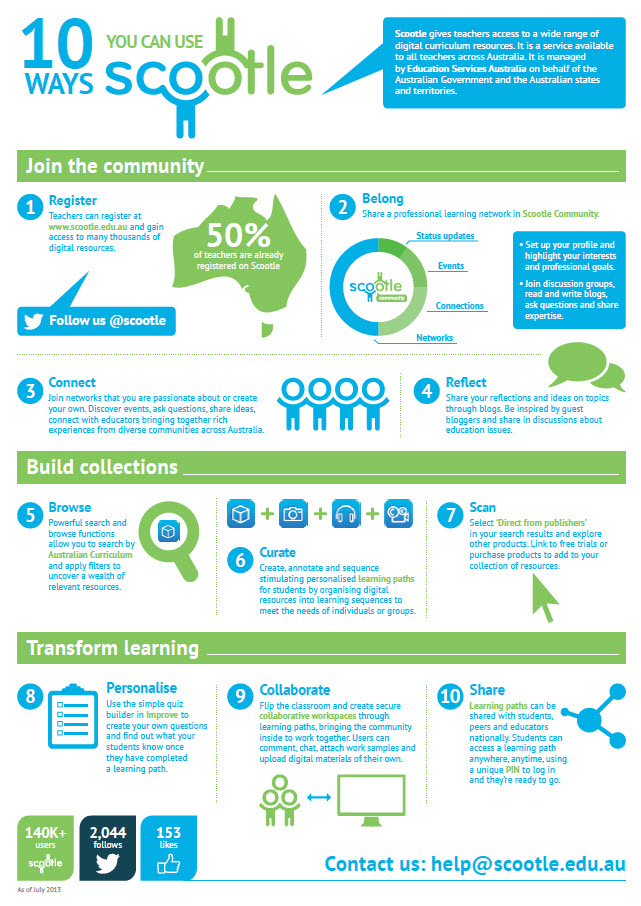
The other online platform they shared was Scootle, this looked like the next level tool that allowed you to create online learning pathways for students that integrated a wide range of digital tools. I did come away wondering if this is how Pond might work in the future?? The image below provides a nice overview of how educators could use Scootle to enhance teaching and learning.
Source: http://blog.scootle.edu.au/files/2013/07/10-ways-1oibkvj.jpg
The next thing I saw was very interesting, for me I liked the way that it answered to an extent that question as to how we might go about assessing and there by raising the status of some of our key competencies. SACE (South Australian Certificate of Education) offers cross-disciplinary qualifications, the crowning glory of which is the SACE Research Project. The Research Project is a semester long assessment in Year 12 that as the website states "students have the opportunity to study an area of interest in depth. They use their creativity and initiative, while developing the research and presentation skills they will need in further study or work." In many ways the SACE Research Project reminded me of the state wide version of the fabulous Albany Senior High School Impact Projects. What I loved about the SACE Research Project is that it took senior assessment out of the context of siloed subjects and focused on the assessing the students ability to actually 'learn to learn'. Considering how the NZC highlights the importance of schools developing 'life-long learners' surely a compulsory national qualification like this would be an excellent start to ensuring all schools were teaching these skills and giving dedicated time for these skills to be developed. Check out the Videos of Student Stories here. I loved the fact that they even hosted a state-wide exhibition of learning to celebrate what the students achieve each year. The sooner we refocus on these broader cross-curricular skills the better!

So all in all it was a great day, both as an opportunity to share and to learn. The week after next I head to Google Teacher Academy in Sydney where I hope to also catch up with ACARA and the NSW agency to learn more about their software developments. We are certainly living in exciting times, just wish we could make a few changes here and now.

Thank you to Sue Chalmers (and Steve Bargh) from NZQA who invited me to attend the event.
Share:
Read More