We talk all about more on Education.....

Showing posts with label makerspace. Show all posts
, , ,

Making is in Our DNA

I have such fond memories of the time I had with both my grandfathers, albeit much too short as one of them was taken from us too soon.  Each of them had such a great fondness for the outdoors, which influenced my decision to pursue degrees in marine environmental science and biology.  William Sheninger, or “Pappy” as we called him, was always outside fixing things and my brothers and I would often hover around to see what he was doing.  Robert Lewis, otherwise known as “Grandpop”, lived on the Jersey Shore and loved to fish in the surf.  Each morning when we visited, he would be out there like clockwork.  My brothers and I loved when he would catch sand sharks and place them in a nearby gully for us to observe. 

Besides the outdoors, both of my grandfathers had an interest in making things in a world that had yet to experience the types of disruptive changes that we are now seeing thanks to the exponential evolution of technology.  It was the late 1970’s and 1980’s after all.  At the time I only viewed these activities as hobbies, but now see that the time they both invested was much more.  Their passion manifested itself into unique creations that involved skill, knowledge, and patience to learn through doing.  Much of what they were doing didn’t make sense as it was the complete opposite of what I was doing in school. 

Pappy was the ultimate engineer as his day job was that of a master mechanic this comes as no surprise. He could take any broken tractor and either fix it entirely or design a whole new contraption.  I remember him re-engineering one tractor so that we could use it to ride through trails we had created in the acres of forest behind our house. It was amazing how he could get almost anything to work no matter what condition it was in.  His hands were always dirty.  Beyond mechanical devices, he was still willing to put his knowledge and skills to help out my brothers and me.  When my twin and I became fascinated with camping, he said let’s make a campsite.  Pappy helped us raise and then level a site in the woods out back.  He also helped us build a fire pit with old scrap metal to ensure that the hot coals wouldn’t spark any nearby debris.  Even though he did not have a college degree, Pappy was one of the most brilliant people I have ever known.

Grandpop also made things with his hands, but his creations were much different than that of my other grandfather.  During the day he was a certified life insurance underwriter for New York Life and had years of higher education beyond a bachelor’s degree. On evenings and weekends, he engaged in another job, but not one to make money.  In the guest room of his house was a workstation where he made jewelry.  One of the favorite stones he loved to work with was the Australian white/light opal. He also worked with amethyst since my grandmother loved the color purple.  They had purple carpet for crying out loud. Grandpop would make necklaces, rings, and pendants all of which he would give to my grandmother and other family members.  He was also fond of Cape May diamonds, which he collected on the beach in Ocean City, NJ. I remember scouring the beach with my brothers to locate these stones for him, after which we would use them to make some incredible jewelry.


With all the hoopla in regards to maker education and makerspaces I wanted to take a minute to share that this is not a new concept. Has it evolved – definitely! The process of making has been in our DNA since the dawn of human civilization to create tools for hunting and survival.  For many of us who grew up before the Internet, we spent countless hours playing with popular toys such as LEGO’s, Lincoln Logs, Construx, and Erector Sets.  It has also been the livelihood for many people and a focus on hobbies or passion projects.  Now we have 3D printers, Arduino’s, Raspberry Pi’s, Little Bits, Makey-Makey’s and an array of other innovative technologies to unleash the maker in all kids.  Regardless of the tool, the process is rooted in constructionism, which can be traced back to constructivism. Jonan Donaldson sums it up nicely:
Terms such as collaborative learning, project-based learning, metacognition, inquiry-based learning, and so on, might be new to some audiences, but they have a relatively long and well-documented history for many educators. The most widely-known and promising pedagogical approach is constructivism grounded on the work of Piaget, Vygotsky, and Bruner. Constructionism brings creativity, tinkering, exploring, building, and presentation to the forefront of the learning process.
It was Seymore Papert who developed the theory of constructionism.  Donaldson goes on to write:
Constructionism, a theory developed by Seymour Papert, articulates a theoretical foundation for learning based on creativity, tinkering, exploring, building, and presentation. Papert had previously worked with Jean Piaget but felt that Piaget’s constructivism placed too much emphasis on the internal mental processes of learners. He insisted that learning occurs not only through learners constructing meaning but also through constructing real-world inventions which can be shared with others. He argues that the construction that takes place ‘in the head’ often happens especially felicitously when it is supported by construction of a more public sort ‘in the world’—a sand castle or a cake, a Lego house or a corporation, a computer program, a poem, or a theory of the universe. Part of what is meant by ‘in the world’ is that the product can be shown, discussed, examined, probed, and admired. It is out there.
The connections above to the maker movement are indiscernible.  He goes on to share the following synopsis of constructionism penned by Kafai, Peppler, & Chapman (2009).
Constructionism is based on two types of construction. First, it asserts that learning is an active process, in which people actively construct knowledge from their experience in the world. People don’t get ideas; they make them. This aspect of construction comes from the constructivist theory of knowledge development by Jean Piaget. To Piaget’s concept, Papert added another type of construction, arguing that people construct new knowledge with particular effectiveness when they are engaged in constructing personally meaningful products.
When it is all said and done, the process of making is a powerful catalyst for meaningful learning.  In some cases, it can be the identification of a problem followed by the development of a workable solution.  How Pappy approached making is an excellent example of this. On the other hand, it can be the creation of meaningful products that are personal in nature, like what Grandpop created or how many kids have used building toys listed previously. Age is irrelevant.  Making is and has been, in our DNA forever.  Sure, the tools have changed, but the will to tinker, create, and invent hasn’t. The role of educators and schools is to seize on the opportunity inherent in this type of learning to unlock the potential in all of our kids not for grades, but instead the gratification of creating something that has meaning to the creator. There is no finer beauty in learning than making something that matters. 

For more ideas, strategies, and resources related to maker education check out this Pinterest board. 

Share:
Read More
, , , , , , , , , , , , , ,

Impact Projects - Prototyping an innovation project


HPSS has prioritised project learning from day one. Inspired by the likes of The Met School, High Tech High and Albany Senior High School we decided very early on that projects would be an important part of our curriculum design and to that end Learning Projects became one third of the HPSS curriculum story.
Connected Learning Design.jpg
HPSS Curriculum


Learning Projects evolved over the last five years (first led by Sarah Wakeford and more recently overseen by Liz, Jayne, Rebecca and Cairan) to become a differentiated range of offerings including Big Projects (more teacher led projects aimed at Years 9-10), Impact Projects (more student led projects based on the ASHS model) and Pathways Projects (aimed at Years 12-13 with a focus on pathways beyond schools such as gateway, work experience and tertiary studies). Whilst the focus may change there is a common learning design model and framework that underpins them all, with students going through a kick off phase, planning, action, review and finally showtime. 

Final.jpg
Projects at HPSS

This year was my first year as a Project Guide and I have to admit, it has proven to be a real highlight, proving the hunch I have long held that project learning is one of the very best ways for students to develop key competencies or what we might refer to as 21C skills. It also provides the mechanism for deliver what can feel like an arbitrary edu buzzword - STEAM learning. For me STEAM is less about students experiencing Science, Technology, Engineering, Arts and Maths (because less face it that is really just the NZC). STEAM is really only powerful when it is genuinely integrated learning framed around solving very real problems or addressing very real issues. There was of course the fact that I had spent much of 2017 dream up a school design (with the planning of the ill-fated City Senior School) that was built around the concept of green innovation projects, or what might be more commonly referred to as social innovation projects. 


So when I had the opportunity to offer an Impact Project I knew I wanted to see how I approach it as if developing an Innovation Curriculum. I began by thinking about what Innovation might look if it were to become a stand alone subject. You can see my initial musings here. I decided that I would be best offering a project that was less about subject expertise (our students choose who they want to work with after experience workshop tasters with each project guide) and more about focusing on supporting students who came with their own ideas and were more in need of a project/innovation coach. 

Here is the project overview: 

The Hatchery - an independent innovation project
Do you have a project idea that doesn’t fit the other project categories??
Are you ready for leading and managing your own independent project?
Do you want to know how to design and create a truly innovative product, service or movement?
Want to learn how to use design thinking processes and agile methodology to make your idea a reality?

Your project may focus on Community, Enterprise and/or Sustainability and may be about people, places or things.

Assessment opportunities will be negotiated based on your project focus. 

In this project you will receive mentoring and support from myself and startup companies from GridAKL in Wynyard Quarter. Students will meet with the residents of GridAKL with an opportunity to get feedback, create partnerships and seek mentoring. There will be an opportunity for students become members of GridAKL’s Tech Cafe which will enable to attend workshops and events. 

There will be an application process where you will need to pitch your project idea to Claire and and potential project mentors.

Futures Thinking and Foresight
We began the process with an introduction to future's thinking and the concept of foresight with students exploring the possible futures of work, money, medicine, transport and fashion. Like with anything, students do't know what they don't know, so it is important to broaden their horizons and challenge their assumptions before refocusing on their interests and projects. 

Innovation Project framework
The main aim of the project was to provide the students with frameworks, tools and protocols which would enable them to transfer their learning to contexts beyond school. In a sense I saw this as a training ground for them becoming entrepreneurs working in somewhere like the GridAKL Startup Hub or Generator. 

After chatting to a range of startup folk I decided there were some key frameworks that would serve them well. The HPSS project process was to be framed by a combination of design thinking and lean startup, with a focus on ensuring the students spent plenty of time within the "problem space" before rushing to the "solution space". Board of Innovation provide a handy summary of this combination.

Source: Board of Innovation
The pitch
The process was kicked off with each student being taught how to develop a pitch deck for their initial ideas. Each student then delivered their ideas to a panel of start up and innovation folk (we had Thoughtwired's Dmitry and James as well as brand strategist Joe Ling and innovation coach Klaus Bravenboer). Their job was to really challenge the student's thinking and to encourage them to hold their initial ideas lightly. After this student's went back to the drawing board to completely rethink or redevelop their initial project concepts.


Innovation strategies and protocols
After that we worked through the following phases and processes:

Planning  - Students researched and assessed a wide range of planning tools. Students then developed gantt charts to map their overarching timelines and used calendars and/or kanban to plan week to week.

Empathy Mapping - students had to interview and discuss ideas with a range of potential stake holders.

Prototyping - Students then moved on to prototyping and fleshing out their ideas via sketches, storyboards or lean canvas templates. 

Partnerships - The students and I called on a whole raft of connections to partner each project with a project partner or mentor. Mentors include Previously Unavailable who have taken in Ria as an intern (her project is focused on her becoming an Innovation Coach). Mia is working with Changing Minds' Tamara Waugh to help develop her online platform supporting teen mental health. Whilst this has been time consuming, establishing these connections is what seems to elevate the projects beyond "school projects" into something way more authentic. It also teaches students to be accountable - a super important skill to develop!

And alas this is about where I got to with them (as I just finished up at end of Term Two to head to my new role at Albany Senior). So whilst I have planned the rest of the year, I won't be there to see them move into lean startup phase and on to preparation for showtime at the beginning of Term Four.

The Innovation Road Trip
However before I left I did manage to take them on an awesome Innovation Road Trip. The intention of this was to show them aspects of the innovation pipeline or ecosystem we are now seeing evolve in Auckland Central. I firmly believe student need to see these spaces in order to see themselves in them. 

We began the day at University of Auckland's new Unleash Space which positions itself as an interdisciplinary Innovation Hub available to all Auckland Uni students. The space is part makerspace and part student start up co-working space. If you want to see an awesomely set up makerspace, then you need to visit! Also it was great to see students just a little older than ours being supported through their own Innovation Projects. 


We then visited Generator on Madden St and the Mason Bros to see what I refer to as the "enterprise" end of the co-working, entrepreneurship and innovation pipeline. Hugely inspiring to see where innovation projects and entrepreneurship could take them.


We then rounded out the day with a tour and series of talks at GridAKL's Startup Hub which represents a potentially more entry (and expansion) level of that innovation pipeline or ecosystem. A number of GridAKL residents shared their stories and insights and it was awesome to here what they had learned in projects being echoed, i.e. hold ideas lightly, really explore the issue and needs of the customer, user or client and learn to be agile and adaptive in your planning. 


So there you go. 

It is most definitely was a prototype and is most definitely is still a work in progress. I do however already see some real success and believe there is real power in developing genuine learner agency by arming students with frameworks, tools and protocols and then giving them plenty of time to try and fail and try again. I am going to miss my Hatchery students dearly but I know I will keep in touch with many and I also know I will have many opportunities to get amongst projects in my new role as Principal at Albany Senior High School, who in many ways I see as the home of Impact Projects in NZ. Freakin' pinching myself! 


Share:
Read More
, , ,

Learning is Not Linear

I think, for the most part, everyone strives for success.  We want to be successful in our professional as well as our personal lives.  I strived to be the best possible principal for my students, staff, and community.  Whether I was successful is a matter of perspective. My evaluations seemed to support the fact that I might have been.  I was far from perfect, but always strived for constant improvement. When I reflect upon what was accomplished during my time leading New Milford High School I think many observers would consider my leadership a success based on what we all accomplished together.  Our digital transformation, backed by evidence of improved learner outcomes, has been well documented.  In the eyes of many this is success. 

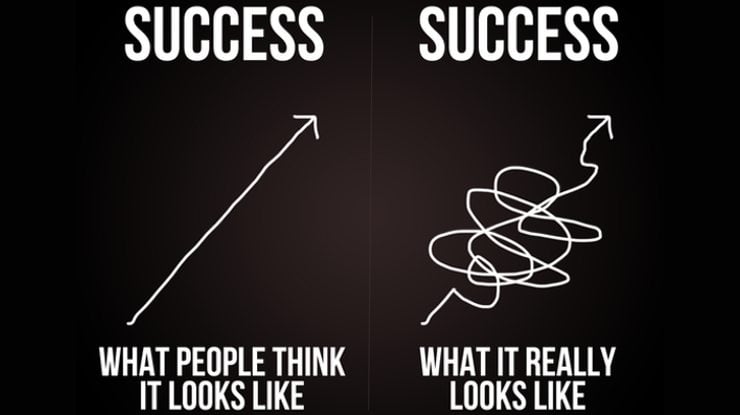
As I have transitioned into my new role over the past two years as a Senior Fellow for the International Center for Leadership in Education, I continue to set the bar high for myself. Again, whether I am successful is open for debate. Some observers might see the publishing of books as an indicator of success. Others could equate keynotes in the same manner.  No matter what someone’s view of success is, I can tell you one thing for certain – it is not a linear process. No one goes from point A to B by following a predetermined path or script. The question then becomes why does school, for the most part, focus on a linear transition that manifests itself in the form of curriculum? This is just one example that flies in the face of unleashing the talents of our students while teaching them what success really is. 


Success results from a series of experiences that include constructing then applying new knowledge, failure, persistence, commitment, perseverance, adaptation, evolution, and most of all reflection. There are so many images out there that illustrate the concept of success being like an iceberg.  In the eyes of many people, success is only what you see or a final product.  The reality is that success really is a unique combination of behaviors, skills, and mindset shifts. The recipe is different for everyone as well as the criteria used to determine success. The fact remains though that the path to success is always convoluted. 


Image credit: Sylvia Duckworth

Learning and success are intimately intertwined.  You can’t be successful if you don’t learn. You learn to eventually experience some sort of success in life. Learning, like success, is anything but a linear process.  As such we need to be more mindful of the experiences and structures in our schools if the goal, which it should be, is to prepare students to succeed in their future.  This includes the new world of work where in a few short years many of the jobs that exist today won’t.  If we continue to prescribe students to a one-size-fits-all approach in classrooms that have remained relatively unchanged we are in a sense forcing them down a linear path. Instead of a focus on learn to do, schools need to shift their practices and create a culture where students do to learn.

Students learn differently and have hidden talents that we must unleash. This is why I love the maker movement and makerspaces in particular.  Nothing, in my opinion, illustrates to kids the many pathways to success than learning with their hands through trial and error, open-ended exploration, and authentic problem solving.  Education needs some disruptive innovation.  We must lend a critical eye to our pedagogy, especially the way we assess and provide feedback to students. It is time for us to work harder to upend the status quo by redefining success in learning. Are you with me?

Share:
Read More