Skip to content
More and more schools are either installing or improving WiFi networks in schools. We still have a long way to go in many places, but the increase in access provides kids with an array of innovative learning opportunities that continue to evolve. With a pedagogy first, technology second if appropriate, approach to instructional design, educators can begin to support and enhance lessons with an array of tools. Sites like Common Sense Education and edshelf make it easy to find the right alignment to the right instructional strategy. However, if a well-designed assessment is in place, then the natural course of action is to allow learners to select the best tool for the task.
Even though the cost of mobile devices has gone down, considerable purchasing challenges persist. With that being said I do want to share a pretty cool and practical idea I stumbled upon during one of my coaching visits with Wells Elementary School. As I was conducting some learning walks with the admin team I noticed some kindergarten students in Deborah Weckerly’s class engaged in blended learning activities using smartphones. As a successful Bring Your Own Technology (BYOT) campus, I wouldn’t have been surprised if in fact some of the students were learning with devices that they had brought in from home. Knowing though that it is never safe to assume, I asked Deborah if the kids were using their own devices. She laughed and said no in a way that affirmed the apparent observation that these students were kindergarteners. I was then left wondering why I even assumed that they might have brought devices to school.
Since the kids weren’t bringing in the devices, I inquired as to how they made it into the classroom. Deborah then showed me a basket that had at least five devices in it at the time but held a total of eight or so when full. She then explained that over the years she had asked her family and friends to donate older smartphones for use in her class instead of trading them in for cash or towards an upgrade. I thought this was a genius idea! She now had enough devices connected to the district’s secure WiFi network to support individual or station-rotation blended learning.

For many learning activities, it’s not the device that matters but instead what learners can do with access to an array of interactives accessible on the Web. I can relate to this as well. As my wife was preparing to upgrade her iPhone, she asked me if I wanted to as well. I thought about this briefly until settling on just inheriting her older 6 Plus. For what I use my smartphone for all I needed was a right amount of storage and the ability to access the Internet for the few apps that I depend on regularly.
Innovative educators like Deborah Weckerly are always looking for ways to improve the learning experience for kids. Regardless of your position, think about reaching out to your family and friends to acquire mobile devices before they are ready to upgrade. These tools can then be used as part of pedagogically sound blended learning or used to support BYOT initiatives where students forget to bring their device or do not have one of their own. In the end, it is essential to always look for ways to improve access and ensure equity so that all learners are provided with a relevant and challenging learning experience.
For more mobile learning resources check out this Pinterest board.
Times are a changing in case you haven’t noticed. We have seen disruptive innovation across so many different sectors of society. If you were to go back in time and pinpoint when disruption began to take off, I would wager that it correlates with the proliferation of the smartphone. Pause a second and think about companies such as Uber and Airbnb. Had it not been for the smartphone their innovative apps might never have come to fruition or experienced immense scalability as they have. Where would many of us be without these or similar apps today?
Now we know that across the world adults have pretty much embraced the smartphone. Some would even go as far to say it has become an additional appendage of many. Statista predicts that approximately five billion people will use a smartphone by 2019. Imagine what this number will be in years to come. With all of this predicted usage, I was curious to know how many of our learners owned a smartphone. Well, I did find some stats for kids in the United States and am willing to bet that other developing countries have similar numbers. The site eMarketer found that 41% of students ages 0-11 and 84% ages 12-17 owned a smartphone in 2016. These numbers are predicted to increase to 49.7% and 92.9% respectively by 2020. Before we know it almost everyone that wants a smartphone across the globe will have one.
The increase in smartphone ownership is a good indicator as to where many schools are headed. Over the years we have seen more embracement of Bring Your Own Device (BYOD) and 1:1 device rollouts. Cost and ease of access will only lead to more schools and districts going down this path. The USDOE’s Office of Educational Technology places emphasis on students and educators having access to a robust and comprehensive infrastructure when and where they need it for learning. The National EdTech Plan goes on to state the following:Preparing students to be successful for the future requires a robust and flexible learning infrastructure capable of supporting new types of engagement and providing ubiquitous access to the technology tools that allow students to create, design, and explore. The essential components of an infrastructure capable of supporting transformational learning experiences include the following:
Ubiquitous connectivity. Persistent access to high-speed Internet in and out of school.
Powerful learning devices. Access to mobile devices that connect learners and educators to the vast resources of the Internet and facilitate communication and collaboration.
High-quality digital learning content. Digital learning content and tools that can be used to design and deliver engaging and relevant learning experiences.
Responsible Use Policies (RUPs). Guidelines to safeguard students and ensure that the infrastructure is used to support learning.
Now don’t get me wrong, all of the above are great. However, there is one crucial aspect that needs to be considered. A focus on logistics must complement the pursuit of a more enriched and challenging learning experience for students in the digital age, which Tom Murray and I lay out in Learning Transformed. In laymen’s terms, this means having enough power to support all of the connected devices. I know it’s not flashy, aligned to research, or even directly connected to pedagogy….but it is a necessity if the goal is to support learning.
To begin, consider conducting an audit consisting of walk-throughs with IT, maintenance staff, teacher leaders, and administrators to determine where there are areas of opportunity. Many outlet additions can be completed over summer and holiday breaks. Polling students to gain their insight is a good move as well. The next step is to determine if there are excess funds in the budget (there is almost always money to spend at the end of the year) to make changes immediately. If not, then this should be worked into the budget for the following year. Below are some practical suggestions to power up your school.


- Transform blocks of hallway lockers into charging bars. During a coaching visit to the Downingtown Area School District, I saw how Lionville Middle School has begun to transition some of their obsolete locker spaces into charging bars (pictures above). Many lockers go unused as our digital learners don't find a need for them so converting them seems like wise decision.
- Overhaul old typing rooms and computer labs. If your middle or high school building isn’t relatively new, then the chances are that there were at least one typing room and numerous computer labs. These rooms had numerous outlets throughout to power devices so a little innovative design can transform these spaces into power hubs.
- Purchase furniture and accessories that have built-in electrical outlets. This strategy seems like a no-brainer when schools are looking to refurbish libraries and comfortable furniture for common areas. Check out Steelcase for an array of ideas and solutions specific to education.
- Replace standard outlets with multi-functional USB combos – When assessing power needs through an audit, count the number of outlets in classrooms, hallways, and common spaces. You can then purchase and replace those outlets with dual USB tamper-resistant models, which will essentially double the available power in any room or space.
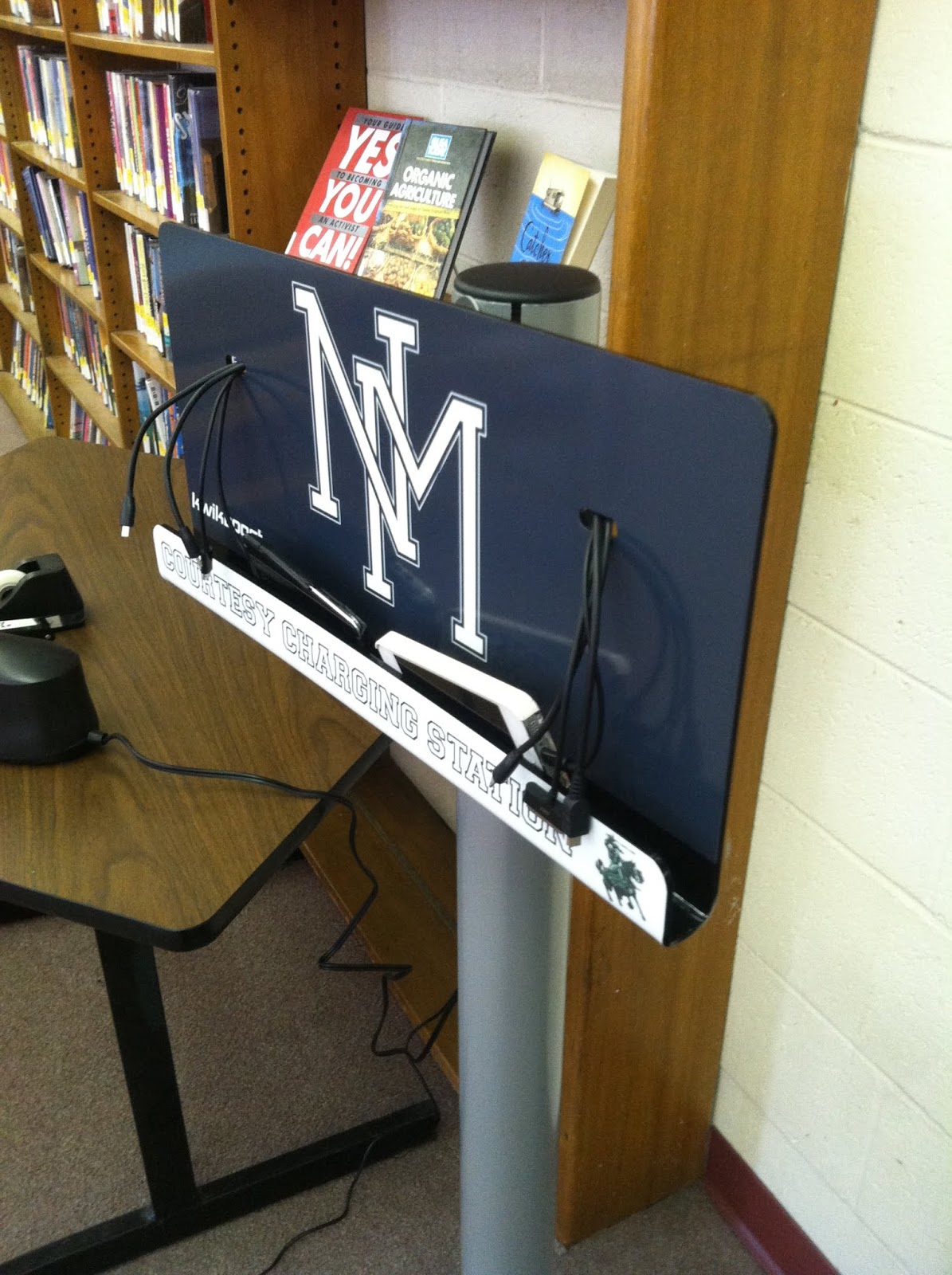
- Invest in school branded charging stations – As the principal, I invested in a few of these mobile stations from a company called Kwikboost and placed them in common areas throughout the building (picture below). One of the benefits was that each station already came with every type of charging cable pre-installed. During events like concerts, plays, and art shows these devices can easily be temporarily placed in these spaces to meet the power needs of stakeholders visiting the school while showing off some school pride in the process.

When more devices, whether school or student-owned, are integrated to support learning an infrastructure must be in place to support the need for power. What unique ideas and strategies have you seen that you would add to the list above?
“Nothing could be more absurd than an experiment in which computers are placed in a classroom where nothing else is changed.” - Seymour Papert
When it comes to improving outcomes in the digital age, efficacy matters more than ever. Billions of dollars are spent across the world on technology with the hopes that it will lead to better results. Tom Murray and I shared this thought in Learning Transformed:Educational technology is not a silver bullet. Yet year after year, districts purchase large quantities of devices, deploy them on a large scale, and are left hoping the technology will have an impact. Quite often, they’re left wondering why there was no change in student engagement or achievement after large financial investments in devices. Today’s devices are powerful tools. At the cost of only a few hundred dollars, it’s almost possible to get more technological capacity than was required to put people on the moon. Nevertheless, the devices in tomorrow’s schools will be even more robust. With that in mind, it’s important to understand that the technology our students are currently using in their classrooms is the worst technology they will ever use moving forward. As the technology continues to evolve, the conversation must remain focused on learning and pedagogy—not on devices.
Unfortunately, technology is not a magic wand that will automatically empower learners to think critically, solve complex problems, or close achievement gaps. These outcomes rely on taking a critical lens to pedagogical techniques to ensure that they evolve so that technology can begin to support and ultimately enhance instruction. If the former (pedagogy) isn’t solid, then all the technology in the world won’t make a difference. As William Horton states, “Unless you get the instructional design right, technology can only increase the speed and certainty of failure.”
As I have said for years, pedagogy trumps technology. This simple concept can be readily applied to how devices are being used in classrooms. In Learning Transformed my co-author Tom Murray and I discussed in detail how technology can be an accelerant for learning. There was a specific reason that this was a focus near the end of our book and not in the beginning. Going back to the sage advice of William Horton we stressed the need to improve pedagogy first and foremost. Improvement lies in our ability as schools and educators to move away from broad claims and opinions to showing actual evidence aligned to good research. This is why efficacy through a Return on Instruction (ROI) is equally as important.
As technology continues to change so must instructional techniques, especially assessment. A robust pedagogical foundation compels us to ensure there is a shift from passive to active learning when it comes to devices in the classroom. Passive learning with devices involves the consumption of information and low-level and engagement instructional techniques such as taking notes, reading, and digital worksheets. On the other hand, active learning empowers students through meaningful activities where they actively apply what has been learned in authentic ways. Are learners in your school(s) using devices passively or actively?
There is a vast amount of research to support why learners should actively use devices. Below is a summary curated by Jay Lynch:Robust research has found that learning is more durable and lasting when students are cognitively engaged in the learning process. Long-term retention, understanding, and transfer are the result of mental work on the part of learners who are engaged in active sense-making and knowledge construction. Accordingly, learning environments are most effective when they elicit effortful cognitive processing from learners and guide them in constructing meaningful relationships between ideas rather than encouraging passive recording of information (deWinstanley et al., 2003; Clark & Mayer, 2008; Mayer, 2011).
Researchers have consistently found that higher student achievement and engagement are associated with instructional methods involving active learning techniques (Freeman et al., 2004 and McDermott et al., 2014).
The primary takeaway from research on active learning is that student learning success depends much less on what instructors do than what they ask their students to do (Halpern & Hakel, 2003).
The natural shift when it comes to device use by students is more active than passive learning. Here is a great guiding question - How are students empowered to learn with technology in ways that they couldn’t without it? It is really about how students use devices to create artifacts of learning that demonstrate conceptual mastery through relevant application and evaluation. What might this look like you ask? Give kids challenging problems to solve that have more than one right answer and let them use technology to show that they understand. When doing so let them select the right tool for the task at hand. This is the epitome of active learning in my opinion.
Passive learning, as well as digital drill and kill, will not improve outcomes. Additionally, our learners need opportunities to develop digital competencies to thrive in a rapidly changing world. Investing in devices only matters if they are used in powerful ways that represent an improvement on what has been done in the past. Knowing is important, but being able to show understanding is what we need to empower our learners to do, especially when it comes to technology.